The ecommerce proactive-chat playbook does not transfer to a law firm's website. The conversion event is asynchronous (a calendar booking that happens days later, sometimes weeks); the per-conversation value is much higher; and the regulatory perimeter is much closer to the conversation surface. Saying the wrong thing in a Shopify chat is a customer-service issue. Saying the wrong thing in a dental-practice chat is a HIPAA exposure. The stakes climb from awkward to audited faster than anywhere else in this playbook.
Below are the signals that predict a booking, how compliance differs by vertical, and the Yokaify configurations that hold up in practice.
What's different about proactive chat for B2B service businesses?
Three structural differences from ecommerce.
The conversion event is asynchronous. A booked consultation is the win; the actual revenue arrives after the consultation, sometimes after a multi-meeting evaluation. The proactive chat's job is to produce the booking; attribution to closed revenue lives in the practice's CRM, not in the chat tool.
Per-conversation value is high; volume is low. A typical mid-sized law firm site receives a few hundred to a few thousand sessions per month, and only a fraction engage a chat, and only a fraction of those book. But at an average matter value in the thousands of dollars, even a small absolute lift in bookings moves real revenue. The math runs in the opposite direction from high-volume, low-AOV ecommerce.
The agent's words are bounded. An ecommerce chat that says "this dress fits true to size" is making a marketing claim. A legal chat that says "you have a strong wrongful-termination case" is practicing law without a license. The agent must operate inside a hard-coded refusal pattern for any advice-shaped question and route to a human consultation.
The first two differences make proactive chat well worth the investment on B2B service sites. The third means you should treat the configuration as a regulatory deliverable, not a marketing one.
| Signal | Threshold | Relative strength | Intervention shape |
|---|---|---|---|
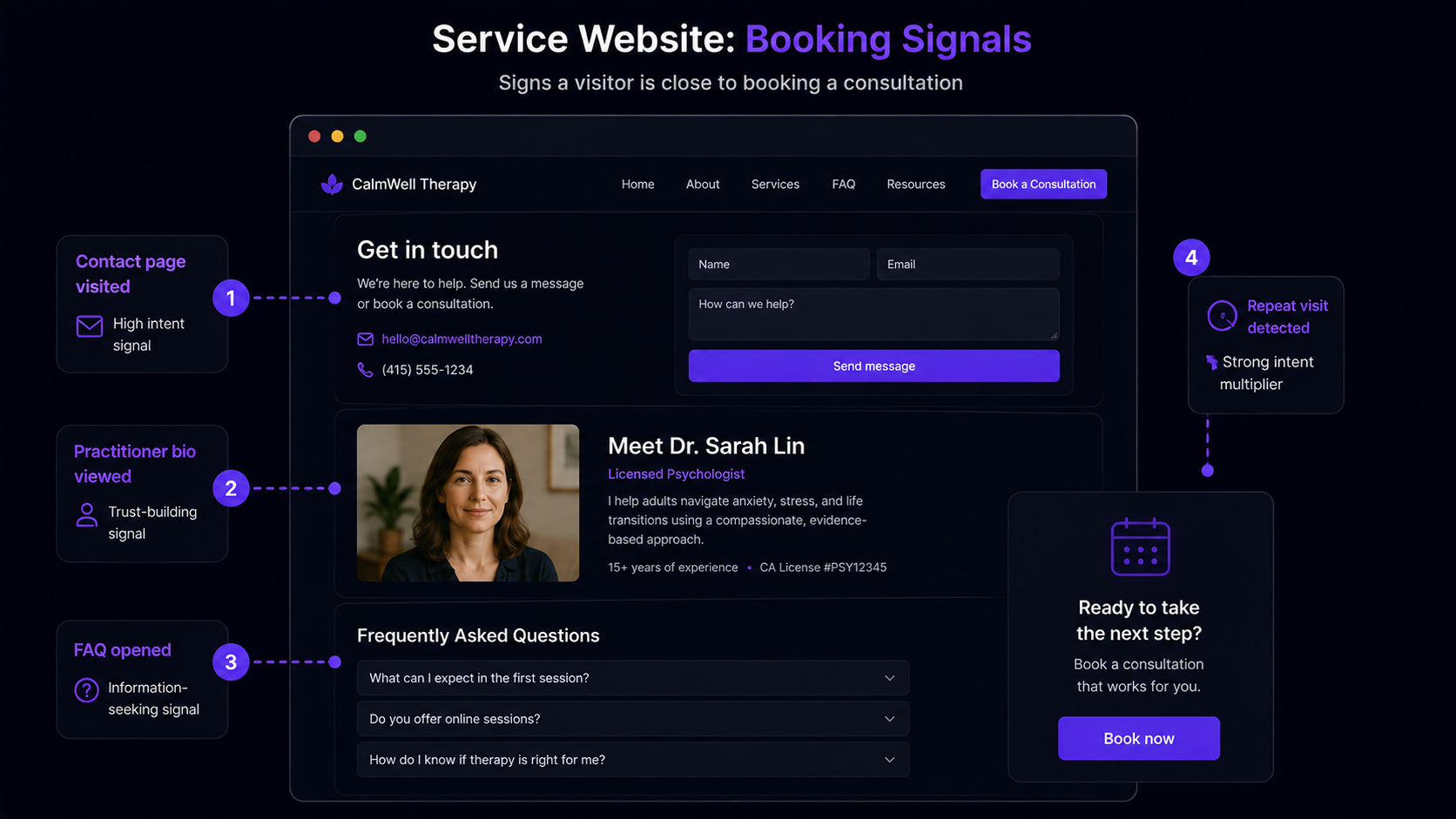
| Contact-page navigation | Visited /contact at any session point | Strongest | Inline question, calendar surface |
| Practitioner-bio dwell | >30s on a specific bio page | Strong | Direct calendar for that practitioner |
| FAQ scroll depth | Read past 60% of the FAQ | Moderate | Specific-question handoff |
| Repeat visit within 14 days | Second session within 14 days | Strong | Where-you-left-off resume, calendar surface |
| Pricing-page dwell | >40s on a pricing or fees page | Moderate | Plan-fit question, no-obligation reassurance |
The single highest-value combination is contact-page navigation plus practitioner-bio dwell.
The lowest-value signal in this stack is generic time-on-page. A long dwell on the homepage often correlates with a returning client navigating the site to find their existing portal link. Generic time-on-site triggers misfire on this cohort consistently. The behavior-triggered chat vs time-on-page chat article covers the underlying reason.
How does the compliance posture differ for legal, dental, and financial services?
Three verticals, three distinct regulatory frames.
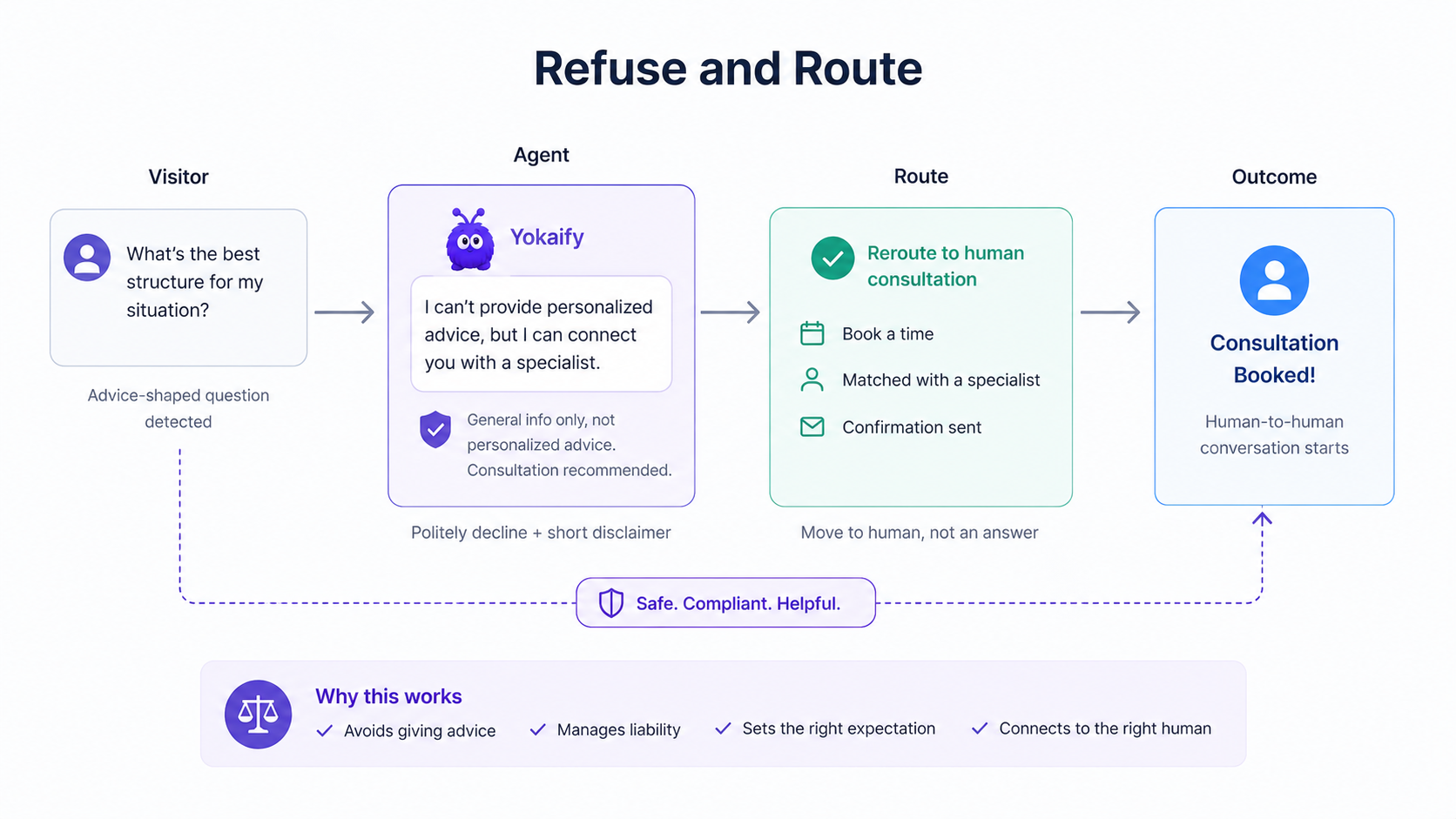
Legal. The chat must not give legal advice. Most US state bar associations distinguish between providing legal information (general, not case-specific) and providing legal advice (specific to the visitor's situation). The line is blurrier than it looks; an agent that says "you might have a case" has crossed it. Configuration: hard refusal for case-specific questions, routing to a free consultation form. Some states (notably New York and California) have additional lawyer-advertising rules; the chat surface and the agent's persona must comply with those state-bar advertising guidelines. The standing reference is the ABA Model Rule 7.1 framework (American Bar Association, 2026 edition).
Dental and medical. The chat must not diagnose or recommend treatment. HIPAA applies to any chat that captures identifiable patient health information; the practice's chat configuration must use a HIPAA-compliant transport and storage layer for the conversation log, or scope the chat to non-PHI questions only. Yokaify's privacy mode (covered in the compliance article) supports a no-PHI configuration that strips identifiable information before storage. The standing reference is the HHS HIPAA guidance (US Department of Health and Human Services, 2026).
Financial advisory. The chat must not give investment advice. RIA (registered investment advisor) firms operate under SEC and state-level regulation; the agent must refuse personalized investment guidance and route to a human advisor. FINRA's communication rules apply to broker-dealers; pre-approval workflows for marketing communications can extend to chat content. The standing reference is FINRA Rule 2210 on communications (FINRA, 2026 edition).
The fourth common vertical, real estate, has lighter regulation but state-by-state license requirements and fair-housing constraints. The agent must not steer or imply preferences based on protected characteristics; the chat configuration must include explicit fair-housing language and refuse any question that asks for neighborhood character based on demographics.
The fifth, consulting and course creators, is the lightest-regulated and the easiest configuration. The constraint is mostly truth-in-advertising — the agent should not promise outcomes the consultant cannot deliver.
What are the Yokaify configurations per vertical?
Each vertical has a baseline configuration shipped on the Growth and Scale tiers. The configuration includes a tuned trigger set, an intervention library scoped to the vertical's allowed interactions, a disclaimer footer, and a hard-coded refusal-and-handoff template for advice-shaped questions.
Legal configuration. Triggers: contact-page nav, attorney-bio dwell, FAQ scroll depth, repeat visit. Interventions: practice-area selector, free-consultation calendar, intake form. Disclaimer: "This is not legal advice. We can connect you with an attorney for a free consultation." Refusal pattern: any case-specific factual question routes to the consultation form, not the agent's response.
Dental configuration. Triggers: services-page dwell, treatment-page hover, FAQ scroll depth, repeat visit. Interventions: appointment booking, insurance-acceptance check, new-patient form. Disclaimer: "We can't provide a diagnosis online. Please book an appointment." Refusal pattern: any symptom or treatment-recommendation question routes to the appointment booking. PHI is scrubbed pre-storage by default.
Real-estate configuration. Triggers: listing-page dwell, agent-bio dwell, valuation-tool entry, repeat visit. Interventions: showing request, valuation handoff, agent-introduction. Disclaimer: standard fair-housing language. Refusal pattern: any neighborhood-demographic question routes to a generic resource.
Consulting / course-creator configuration. Triggers: services-page dwell, case-study scroll, pricing-page dwell, repeat visit. Interventions: discovery-call calendar, course-fit quiz, content-resource handoff. Disclaimer: lighter; mostly truth-in-advertising guardrails on outcome claims.
The configurations are starting points; each practice tunes the disclaimer text and the practice-area mapping at install. The integration approach for the most common stacks is documented in the Shopify chatbot guide (for service-business storefronts on Shopify) and WooCommerce chatbot guide (for WordPress-based practice sites).
When does proactive chat hurt instead of help on a B2B service site?
Existing-client interruption. Returning clients use the site to find their portal link, schedule a follow-up, or look up an office address. A "ready to book a consultation?" intervention to a client who has been with the practice for three years signals that the agent is not paying attention. The fix is a returning-visitor cookie or a logged-in flag if the practice exposes one; the agent suppresses the prospect-stage trigger set when the visitor is recognized.
Advice drift. The agent answers a soft-advice question because it can. "What's the typical sentence for a first DUI?" is a factual question with a specific answer; an agent that gives the answer is approaching legal advice. The fix is a refusal-and-route template that handles advice-shaped questions specifically. Yokaify's classifier flags advice-shaped questions before they reach the response layer.
Disclaimer inflation. The well-intentioned response: stack every disclaimer on every message. The result: the chat becomes legalese-heavy and visitors disengage. The fix is a single visible disclaimer footer on the chat surface, plus context-specific disclaimers on the specific intervention templates that need them. Most messages do not need an inline disclaimer.
What this means for B2B service buyers picking a chat tool
Three concrete shifts when evaluating a chat product for a service-business site:
- Disqualify any tool that does not ship a vertical-specific configuration. A generic chat product does not have the refusal-and-route templates needed for legal, medical, or financial. Ask explicitly which verticals the vendor has shipped configurations for and whether the configurations are reviewed by counsel. 2. Insist on a hard-coded refusal pattern for advice-shaped questions. The product's classifier should detect advice intent and route, not answer. Ask the vendor to walk through three sample advice-shaped questions and show the response. 3. Verify the privacy and storage layer. For dental, medical, and financial, the chat-log storage is a regulatory question. The product needs an enterprise-grade storage tier, and for HIPAA-applicable use, a BAA is non-optional.
The shorthand: B2B service proactive chat is half lead generation and half regulatory compliance. The product that helps the practice is the one whose configuration is shipped, vetted, and tunable per vertical, not the one with the prettiest widget.
Further reading
- GuideWebsite lead capture in 2026The lead-form layer that the chat hands off to.
- GuideThe proactive-engagement referenceThe full implementation guide for the trigger stack.
- BlogProactive chat compliance: GDPR, ePrivacy, and the new 2026 ICO guidanceThe cross-vertical compliance reference this article points into.
- BlogProactive chat for SaaS landing pagesThe adjacent non-cart vertical with a different signal stack.
- ToolConversion rate benchmarkerCalibrate booking-rate expectations against your vertical.
Frequently asked questions
The conversion is a booked consultation, not a purchase. Signals reward contact-page nav, bio dwell, FAQ scroll, and repeat visits. The agent must not give legal, medical, or financial advice.
Last updated June 10, 2026.