
Compliance used to mean clicking "I agree" once and forgetting about it for two years. That is no longer the posture. Today the rules reach into the signals you read, the cookies you set, and the nudges you show. The shift has been gradual, but the work it creates is real.
Below are the four regulatory anchors that apply, how each one touches proactive-chat triggers, and what a workable baseline looks like in 2026.
What's the 2026 compliance landscape for proactive chat?
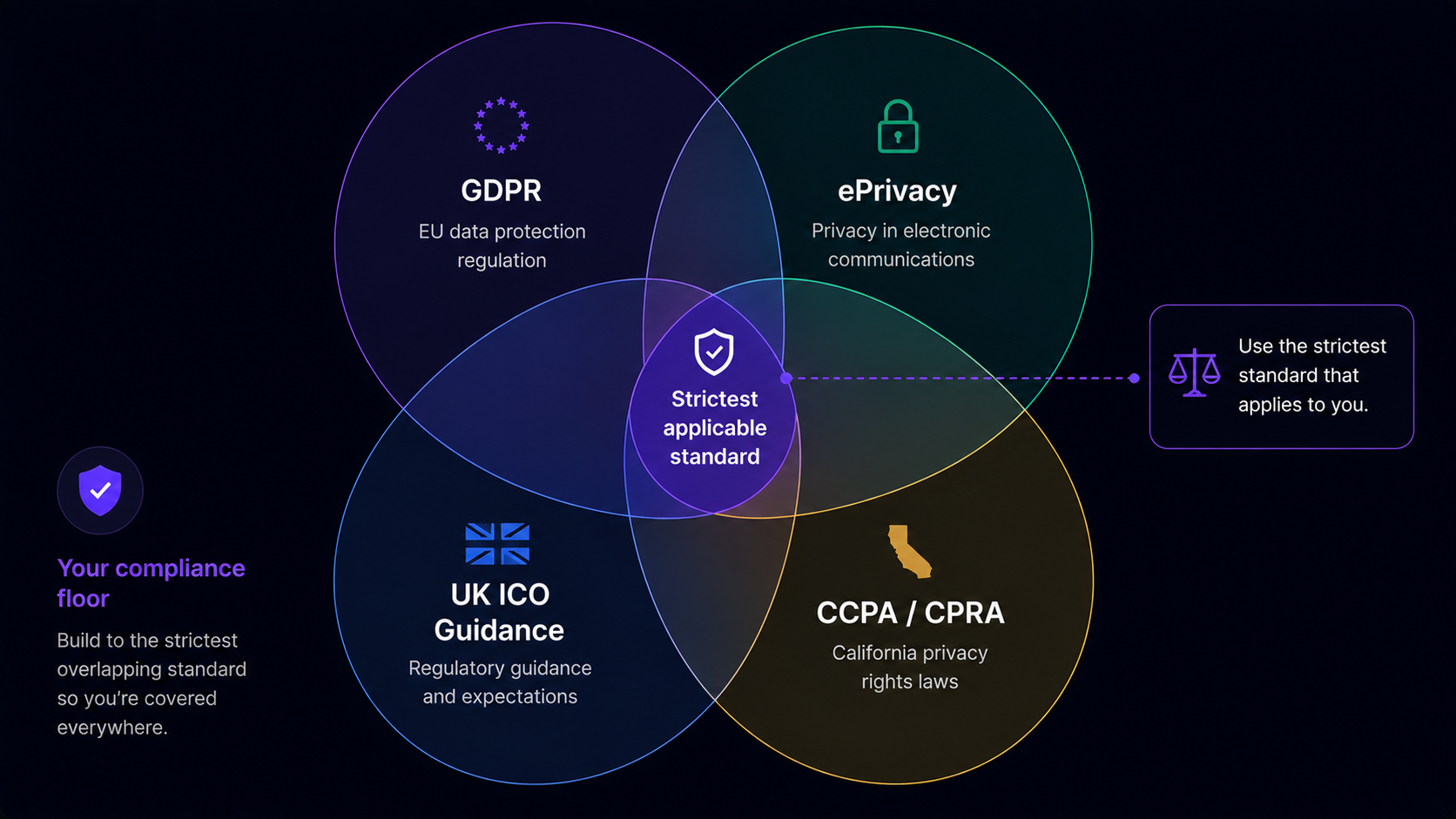
Four anchors apply concurrently in most deployments.
GDPR. The European general regulation on personal data. Article 6 enumerates lawful bases for processing; legitimate interest, consent, and contractual necessity are the three that apply to most behavioral chat use cases. The European Data Protection Board has continued to publish guidance through 2024-2026 that narrows the conditions under which legitimate interest applies to behavioral processing.
ePrivacy. The EU directive that governs storage and access to information on a user's terminal device. The 2026 update tightens the consent requirement for tracking technologies and clarifies the conditions for the strictly-necessary exemption. Proactive chat that persists state across sessions almost always crosses the storage threshold.
UK ICO 2026 dark-patterns guidance. The UK Information Commissioner's Office published updated guidance in 2026 on harmful design patterns, including specific named patterns relevant to chat triggers. The guidance does not ban proactive chat; it constrains specific manipulative shapes and requires honest claims.
CCPA / CPRA. California's general privacy regulations. The CPRA expanded CCPA in 2023 and continues to set the de facto floor for US privacy compliance. The framework that matters most for chat is the right to opt out of sale and sharing, and the right to know, delete, and correct.
The four overlap unevenly across jurisdictions. A visitor in California sees CCPA / CPRA. A visitor in Berlin sees GDPR plus ePrivacy. A visitor in Manchester sees UK GDPR plus the ICO guidance. The merchant-side practical answer: configure for the strictest applicable standard for your traffic mix; do not try to detect-and-vary the configuration per visitor unless you have legal review.
When is GDPR consent required for behavioral signals?
The Art. 6 lawful-basis question is fact-specific. Three rough zones:
Likely legitimate interest (no consent strictly required). In-session, session-only, non-identifying behavioral signals — scroll position, dwell time, hover events on a page the visitor is currently viewing — that are processed and discarded without persistent storage or cross-session profiling. The lawful basis still requires a documented balancing test (the EDPB has been clear on this), but the test usually passes.
Almost always consent required. Persistent identifiers across sessions, cross-domain tracking, combination of behavioral data with identifying information (email, phone, account ID), and behavioral processing that the visitor would not reasonably expect. The ePrivacy storage requirement also fires here whenever the persistence uses cookies or local storage.
Gray zone. Single-session pseudonymous identifiers (a session-only ID), in-browser signals used to tell bots from real visitors. The lawful basis is defensible under legitimate interest in many fact patterns but the line is not bright. The pragmatic posture: surface a minimal notice, let the visitor opt out, document the balancing test in your privacy assessment.
The Yokaify default for new EU traffic is Minimal mode (in-session only, no cross-session persistence) until the visitor consents to Full mode. The default avoids the consent fight on first contact while still capturing most of the proactive-chat lift.
What does the 2026 ePrivacy update change?
Two substantive changes worth naming.
Legitimate interest is not a valid lawful basis for cookie storage. The 2026 clarification rules out the workaround of using legitimate interest to set tracking cookies without consent. The ePrivacy directive's storage rule is independent of GDPR's Art. 6 basis; consent is required for non-strictly-necessary storage regardless of the GDPR basis claimed.
Narrow non-tracking-analytics exemption. The update introduces a tightly-defined exemption for analytics that meet specific conditions — first-party only, no cross-site profiling, aggregate-only output, short retention. Proactive-chat behavioral logging usually does not fit because the chat persists state at the visitor level for personalization, which crosses the aggregate-only line.
The practical implication for a chat product: any persistent identifier (cookie, localStorage, IndexedDB) used by the chat layer needs a consent surface and a working opt-out. The Yokaify implementation uses a dedicated yokaify_session cookie with a documented purpose and a configurable lifetime; the cookie is suppressed in Minimal and Off modes.
How does the UK ICO 2026 guidance treat proactive chat triggers?
The ICO 2026 harmful-design-patterns guidance names chat-relevant patterns explicitly. Three are most relevant for proactive-chat configuration:
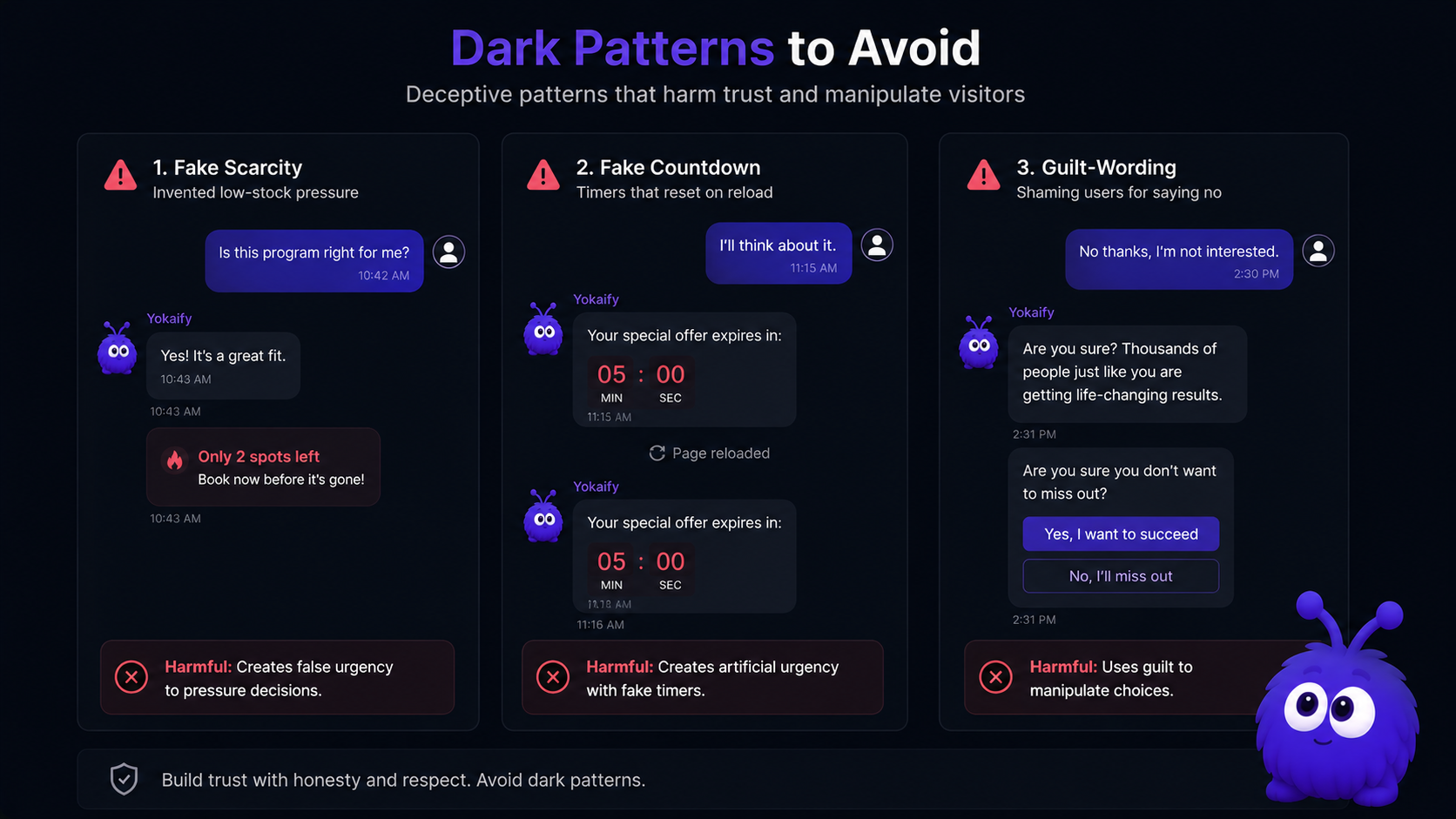
Artificial scarcity. A "only 3 left in stock" message that does not reflect real inventory state is a harmful pattern under the guidance. Proactive chat that surfaces low-stock cues must connect to a real inventory signal; faked scarcity is in scope for enforcement.
False urgency. "This offer ends in 5 minutes" with a timer that resets on every page load is a harmful pattern. A real urgency window (an actual sale that ends at 11:59 PM) is acceptable; a synthetic countdown is not.
Confirmshaming. Refusal options framed as self-deprecating language ("No thanks, I don't want to save money") are flagged as harmful. The visitor's refusal path must be neutrally worded and as easy to take as the accept path.
The guidance does not ban proactive chat. It requires that the underlying claim is true, the urgency is real, and the refusal is uncomplicated. The Yokaify intervention library was reviewed against these patterns in early 2026; the proactive-chat guide documents which intervention shapes are pre-cleared and which require operator configuration of the underlying signal (real inventory feed, real promotion end-time).
What are CCPA and CPRA opt-out requirements?
CCPA and CPRA require a clear opt-out from sale and sharing of personal information. Three operational notes for chat products:
Service provider relationship. A chat vendor that processes behavioral data only on behalf of the merchant, under a contractual service-provider relationship, typically does not trigger the sale-or-sharing test for that merchant's visitors. Yokaify operates as a service provider by default; the merchant remains the controller.
Right to know, delete, and correct. The merchant must be able to surface a visitor's chat history (right to know), delete it (right to delete), and correct it (right to correct) within the regulatory response window. Yokaify exposes these via the admin console; the merchant ships the visitor-facing form.
Global Privacy Control signal. CPRA recognizes the Global Privacy Control browser signal as an opt-out signal. The chat layer must respect GPC where it applies; the Yokaify default treats GPC as a soft opt-out that disables cross-session persistence.
What do Yokaify's three privacy modes do?
The three modes are configuration presets that bundle the key consent-relevant behaviors.
| Behavior | Full | Minimal | Off |
|---|---|---|---|
| In-session behavioral signals (scroll, dwell, hover) | Read | Read | Not read |
| Cross-session persistence | Yes | No | No |
| Persistent cookie / localStorage | Yes | Session-cookie only | None |
| Behavioral profile on the server | Stored | In-memory only | Not stored |
| Proactive triggers fire | Yes | Yes (in-session only) | No |
| Reactive chat available | Yes | Yes | Yes |
| Chat conversation log retention | 90 days | 30 days | Session only |
| Default for new EU traffic | After consent | Yes | Optional |
| Default for new US traffic | Yes | After GPC | Optional |
The mode selection is a per-visitor flag, not a per-merchant flag. A merchant can run Full mode for consenting EU visitors, Minimal for non-consenting EU visitors, and Full for US visitors who have not asserted GPC, all in the same deployment. The configuration lives in the website lead capture consent layer.
What's the line between PII and non-PII behavioral signals?
A pragmatic working definition for chat:
Non-PII signals. Scroll position, dwell time, hover events, cursor movement, viewport size, page URL, referrer (without query parameters that contain identifiers). Aggregate or session-only; do not link to a person on their own.
Pseudonymous signals. Session ID, visitor ID assigned by the chat layer, returning-visitor flag tied to a cookie. These are personal data under GDPR (the EDPB has been clear that pseudonymous identifiers are personal data) but the data subject is not directly identifiable from the signal alone.
PII signals. Email, name, phone, account ID, IP address (in most EU readings), payment-instrument hash, anything the visitor types into a form. These are personal data under all four anchors.
The implementation distinction matters because the lawful-basis analysis is different at each tier. Yokaify's behavioral engine reads non-PII signals by default; pseudonymous identifiers are mode-controlled; PII signals are read only when the visitor types them and the visitor's intent to share is explicit.
What's the minimum-viable compliance posture?
Five steps that map onto most deployments:
- Classify each signal. Document whether each behavioral signal is non-PII, pseudonymous, or PII. The classification is the input to the lawful-basis analysis. 2. Pick a privacy mode per cohort. Match the mode to the consent posture you can obtain. Minimal is the safest default for non-consenting EU traffic; Full is appropriate after consent or in jurisdictions where consent is not required. 3. Ship a visible notice and consent surface. A pre-checked consent box does not work under GDPR. The consent surface must be opt-in, clearly worded, and as easy to refuse as to accept. 4. Ship a working opt-out and right-to-delete path. A privacy notice without a working opt-out is a regulatory exposure. The chat product must expose the data-subject rights surface in the merchant's admin console. 5. Review when guidance updates. The 2026 anchors are not the last word. The ICO publishes refreshed guidance regularly; the EDPB publishes opinions; CPRA regulations continue to evolve. A quarterly review of the configuration against the latest published guidance is the cheapest insurance available — and a great deal cheaper than explaining yourself to a regulator after the fact.
What this means for buyers picking a chat tool
Three concrete shifts when evaluating a chat product on a 2026 compliance basis:
- Disqualify any tool that does not document its lawful basis. A vendor that cannot explain the GDPR basis under which their behavioral processing operates is shipping the regulatory risk to the merchant. 2. Insist on configurable privacy modes. A single-mode tool forces the merchant into the strictest posture or the riskiest one. A tool that ships Full / Minimal / Off (or equivalent) lets the merchant match the mode to the consent posture they can obtain. 3. Verify the opt-out and data-subject-rights surface. Ask the vendor to walk through how a visitor in California asserts a right to delete and how a visitor in Germany withdraws consent. The walkthrough should take seconds, not minutes; if the vendor cannot demonstrate it, the merchant inherits the gap.
The shorthand: behavior-driven chat reads personal data; personal data has a regulatory perimeter; a 2026-grade chat product is built to operate inside that perimeter, not around it.
Further reading
- GuideThe 2026 proactive chat referenceThe implementation guide that includes the consent surface configuration.
- GuideWebsite lead capture in 2026The consent layer at the lead-form boundary.
- BlogProactive chat for B2B service businessesVertical-specific compliance configurations for legal, dental, financial.
Frequently asked questions
GDPR Art. 6, the 2026 ePrivacy update, the UK ICO 2026 dark-patterns guidance, and CCPA/CPRA. The four overlap; the strictest applicable standard sets the floor.
Last updated June 10, 2026. Regulatory references are summaries of public guidance current at the time of writing and are not legal advice.