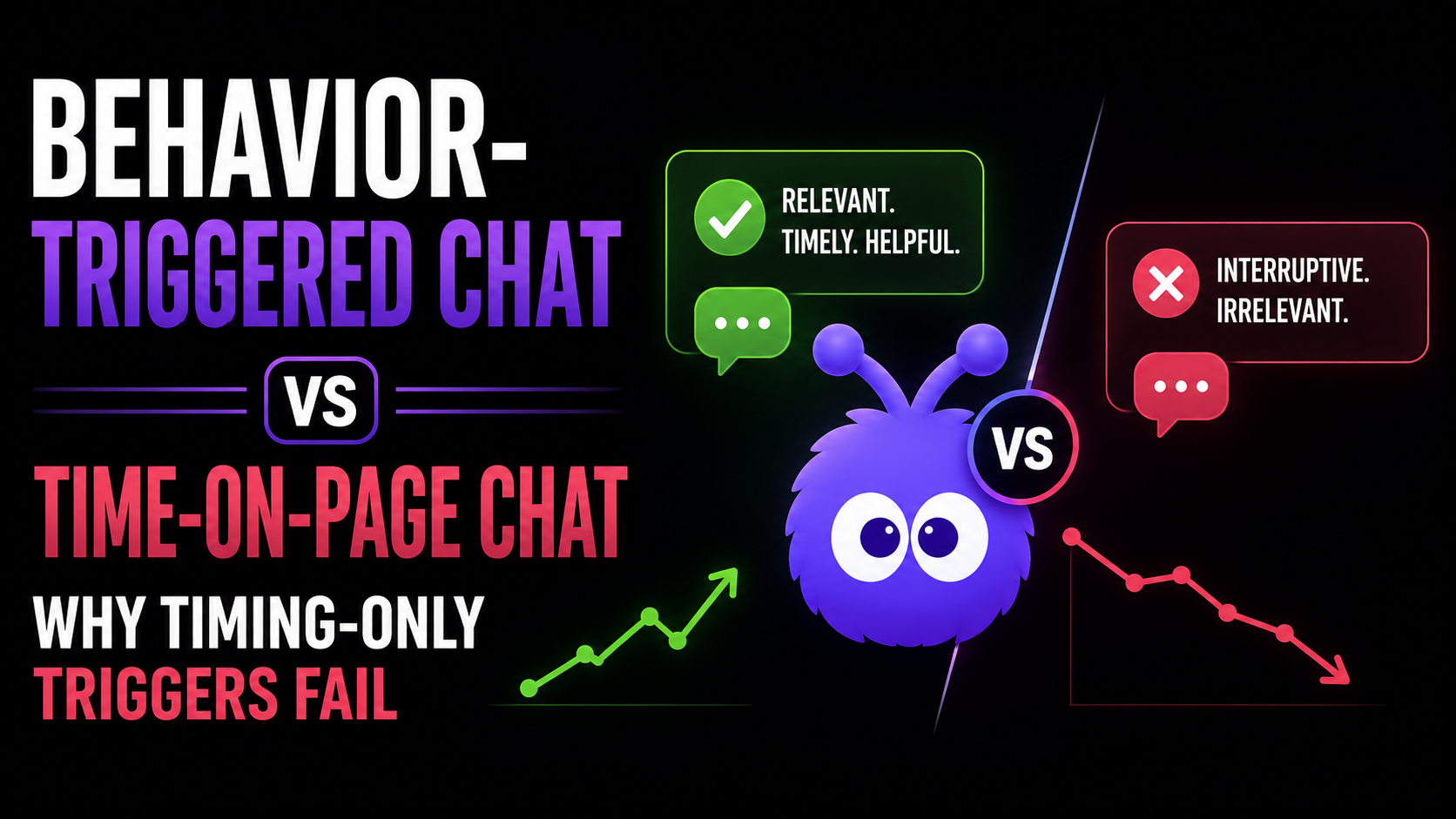
For years, proactive-chat advice treated "time on page" as the obvious trigger. The logic seemed sound: the longer someone stays, the more interested they must be, so eventually you offer help. It is a tidy intuition, and it does not hold up against how people actually behave in 2026.
This article covers why timing-only triggers underperform, which behavior signals replace them, and how the two relate.
What does a time-on-page trigger actually measure?
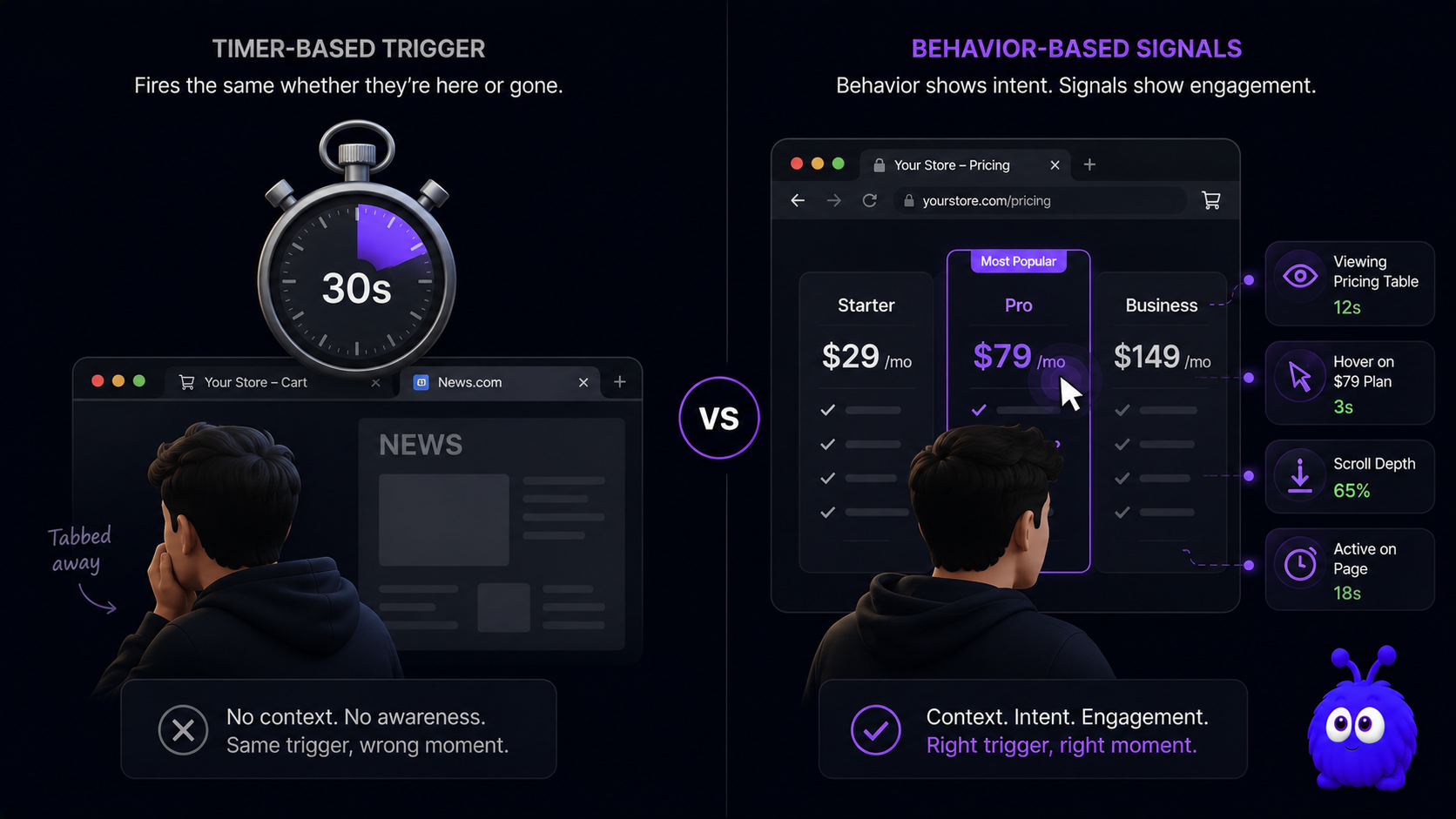
A 30-second timer fires when the visitor has been on the page for 30 seconds. That is all it knows. It does not know whether they read anything, scrolled, hovered over a price, or moved the cursor at all. So it fires identically on three very different people:
- The visitor who landed, scrolled to the pricing table, and is mid-comparison.
- The visitor who tabbed away to read email and forgot the page exists.
- The visitor whose cursor has not moved in 25 seconds because they are not looking at the screen.
A message tuned for all three is tuned for none. The reader finds it interrupting, the tabbed-away visitor never sees it, and the not-looking visitor wanders back to find a chat box that has been cheerfully holding a conversation with an empty room.
The old workaround was to push the delay out to 45 or 60 seconds to filter the noise. That cuts the noise a little, but it does not fix the underlying problem: time is not a measure of intent.
Which behavior signals actually predict intent?
The signals worth acting on read what the visitor is doing, not how long they have been there (the intent signal glossary entry covers the category). A few examples:
- Scroll depth. Someone past 75% of a long pricing page has shown engagement; someone stuck at the top has not.
- Dwell on a specific element. A pause on a price, a CTA, or a comparison row means something different than a pause on the hero.
- Hover pattern. Cursor lingering over Add to Cart for a few seconds without a click reads as consideration without commitment.
- Exit-intent vector. Cursor heading for the top of the viewport on desktop, or a rapid scroll-to-top on mobile.
- Cart state. A non-empty cart, time since the last add, a change in items.
- Return visit. A second visit within a day points to meaningfully higher intent.
The strength comes from combining a couple of these. "Heading for the exit, with a non-empty cart, after dwelling on the cart page" fires on a much narrower, much higher-intent group than "60 seconds on any page."
How big is the gap between the two?
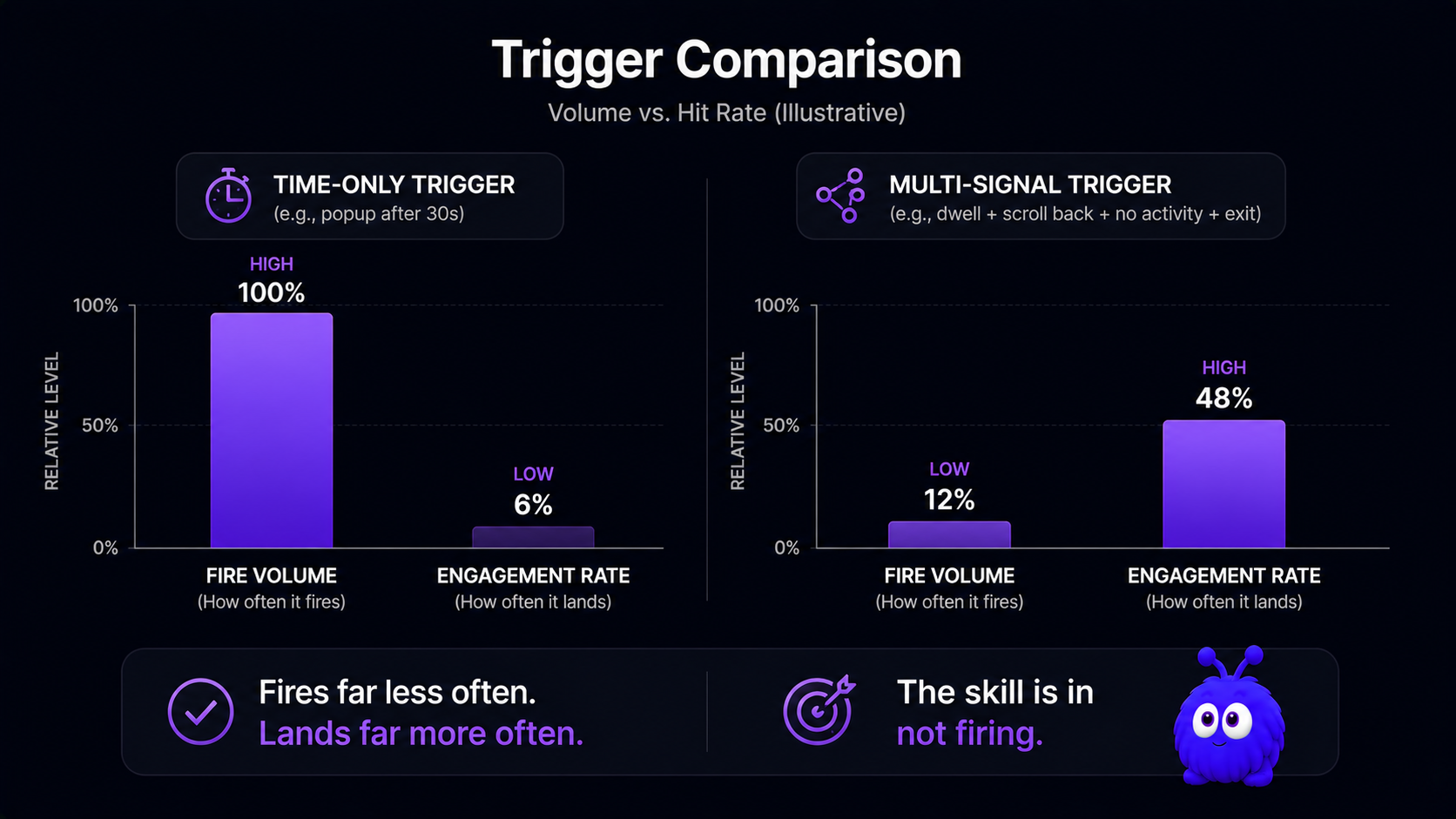
The most useful way to see it is in two parts.
First, trigger volume drops as quality rises. A time-only trigger fires constantly; a multi-signal trigger fires selectively, on a small fraction of sessions. The sophistication is in not firing.
Second, engagement rises sharply when it does fire. Because the multi-signal trigger has already filtered for intent, the person it speaks to is far more likely to engage than the person a time-only trigger interrupts at random.
Put together: the behavior-driven approach speaks up far less often but lands far more often when it does. Fewer interruptions, higher hit rate, and a better experience for the visitors who never needed to be bothered in the first place.
Why do timing-only triggers hit banner blindness?
Banner blindness is the learned reflex of ignoring repeated, low-value UI. Persistent elements a visitor classifies as "not useful" get tuned out fast: banner-blindness reaches 78% within two visits for that kind of UI (Nielsen Norman Group, 2026). Content was rephrased for compliance with licensing restrictions.
Time-on-page triggers fall straight into that pattern because:
- The same message fires every visit (unless session memory is on).
- The timing has nothing to do with the visitor's current goal.
- They have seen variants of the same "still there?" trigger across thousands of sites.
Behavior triggers escape it because they fire on a smaller, more contextual group, the message can speak to what the visitor was actually doing ("noticed you have been comparing Pro and Scale..."), and the timing lines up with their goal, so it does not get filed away as noise.
How can timing be combined to actually work?
Timing does not have to be thrown out. It has to be combined with something.
- Time plus URL. "30 seconds on the pricing page" is far better than "30 seconds anywhere." The URL adds context.
- Time plus scroll depth. "60 seconds on the pricing page and scrolled past 50%" filters out the tabbed-away crowd.
- Time plus return visit. "30 seconds on the pricing page and a second visit within a day" is a strong consideration signal.
The more relevant signals you layer in, the more the timing actually means.
What does Yokaify do in practice?
Yokaify watches behavior signals together rather than treating any one of them, time included, as a trigger on its own. Time is a weak signal, so it is weighted lightly and never fires by itself; it always needs a co-signal like scroll depth or exit-intent to matter.
The part that matters for operators is that you do not configure raw trigger rules. You pick an outcome, "recover cart-abandoners," "qualify hesitant pricing-page visitors," "engage returning blog readers," and the engine maps that goal to the right combination of signals behind the scenes. You choose the goal; the system chooses how to read for it.
What this means for buyers
Two shifts when you are picking a chat tool in 2026:
- Walk away from anything that only offers time-plus-URL triggers. That is a 2018 architecture, and the lift numbers in the brochure will not match what you measure after install.
- Ask exactly which signals the triggers can read. "Behavior-driven" with no specifics is a marketing claim. A real answer names the signals.
The short version: behavior predicts intent; timing predicts boredom. Pick the trigger that matches the signal.
Further reading
Frequently asked questions
Time triggers fire after N seconds, regardless of behavior. Behavior triggers fire when actual signals (scroll, hover, exit-intent, cart state) cross an intent threshold. Stopwatch versus decision engine.
Last updated June 10, 2026.