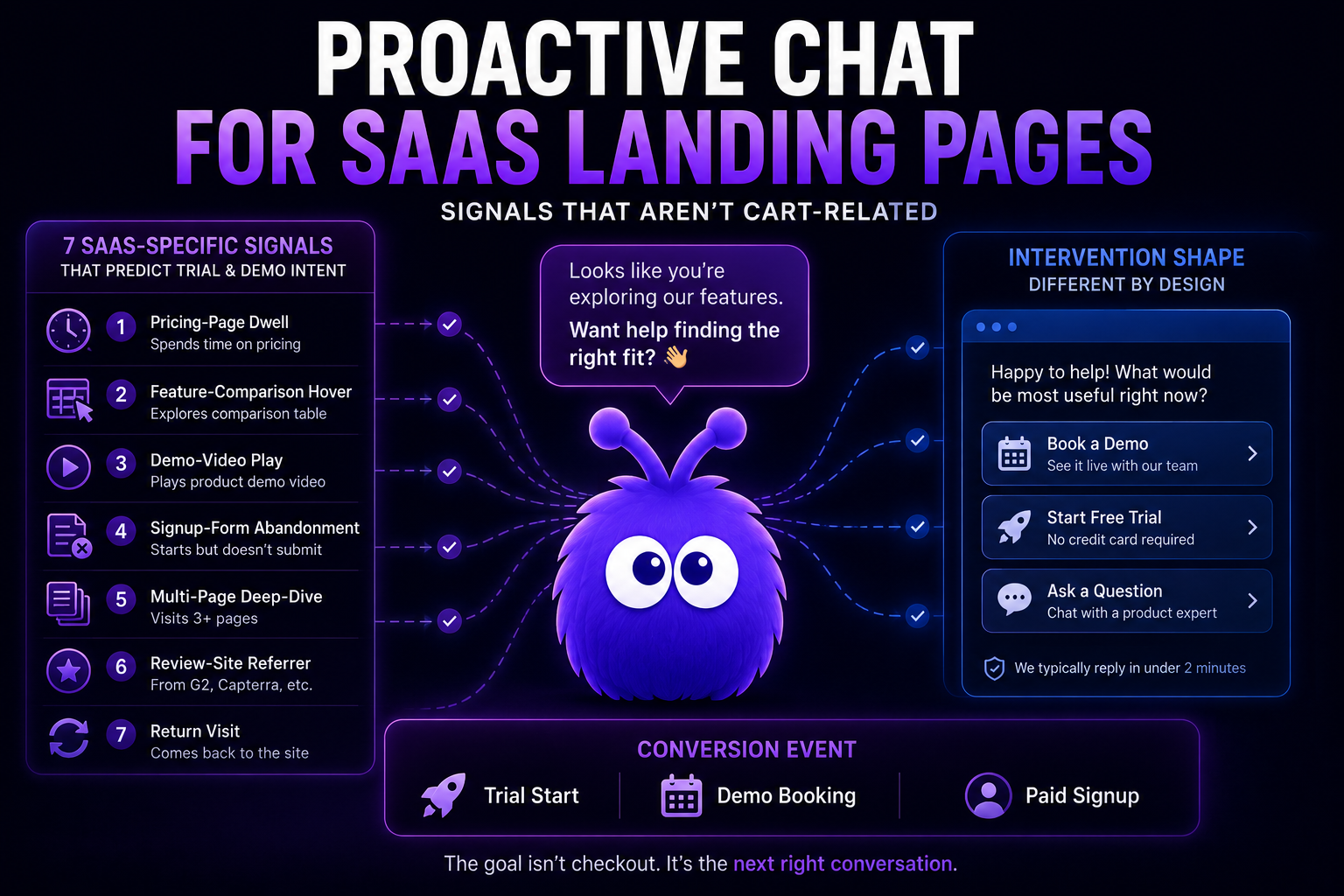
Most proactive-chat playbooks were written for Shopify and DTC stores, where cart state is the signal everything else orbits. SaaS marketing pages break that model. There is no cart, the signals are sparser, and the conversion often lands days later as a calendar booking rather than a checkout in the moment.
So the signal stack has to change. The signals worth reading on a SaaS site are not the ecommerce ones, the interventions end differently, and there are a few pages where proactive chat does more harm than good.
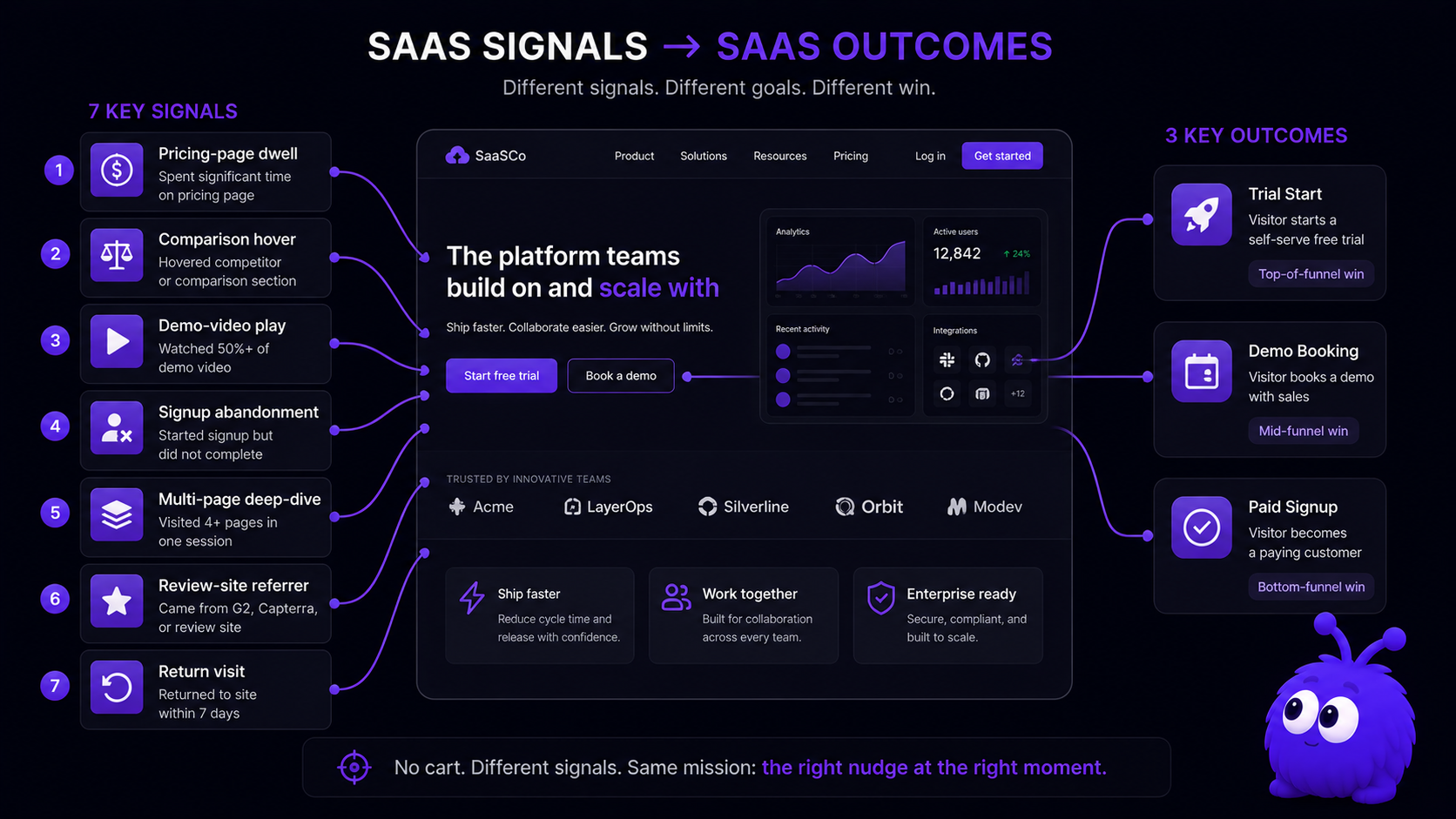
How are SaaS signals different from ecommerce signals?
The most concrete difference: ecommerce signals describe a transaction in progress, SaaS signals describe a decision in progress. The cart-state signal on a Shopify product page is binary and current; either the visitor has the item or they do not. The pricing-page-dwell signal on a SaaS marketing site is continuous and historical; the visitor has been comparing for forty seconds, may have left, may come back, and the eventual conversion (a demo request) might happen six days later.
That changes three things in how the proactive chat reads the session:
Latency tolerance is higher. A 200ms intervention on a cart page is the right answer because the visitor is moments from leaving. The same 200ms intervention on a SaaS pricing page lands too early, while the visitor is still reading. On a SaaS page the trigger waits for a dwell threshold (30-60s) plus a second signal, not the dwell threshold alone.
Signal density is lower. A typical ecommerce session reads several distinct behavior events; a typical SaaS marketing session reads fewer. With less to go on, each signal has to carry more weight before the agent acts.
The conversion is asynchronous. A SaaS visitor who books a demo now will convert (or not) in a Sales call held next Tuesday. The proactive-chat win is producing the booking; the closed-won attribution belongs to a later stage.
What are the seven SaaS-specific behavior signals?
| Signal | Threshold | Predicts | Intervention shape |
|---|---|---|---|
| Pricing-page dwell | >40s on /pricing | Active price evaluation | Plan-fit question, contract-length flexibility |
| Feature-comparison hover | Hover on 3+ comparison cells | Mid-evaluation, comparing tiers | Differentiator surface, tier recommendation |
| Demo-video play | >50% of video duration | High-intent learner | Calendar handoff, custom-demo offer |
| Signup-form abandonment | Started form, left before submit | Conversion-proximate friction | Field-level help, no-credit-card reassurance |
| Multi-page deep-dive | Pricing + docs + about in one session | Buyer-cycle research | ROI calculator, security one-pager |
| Review-site referrer | Referrer matches G2, Capterra, Trustpilot | Pre-qualified by external review | Comparison-page link, trial accelerator |
| Return visit | Second visit within 7 days | Active consideration | Where-you-left-off resume, demo handoff |
A few of these are worth a closer look.
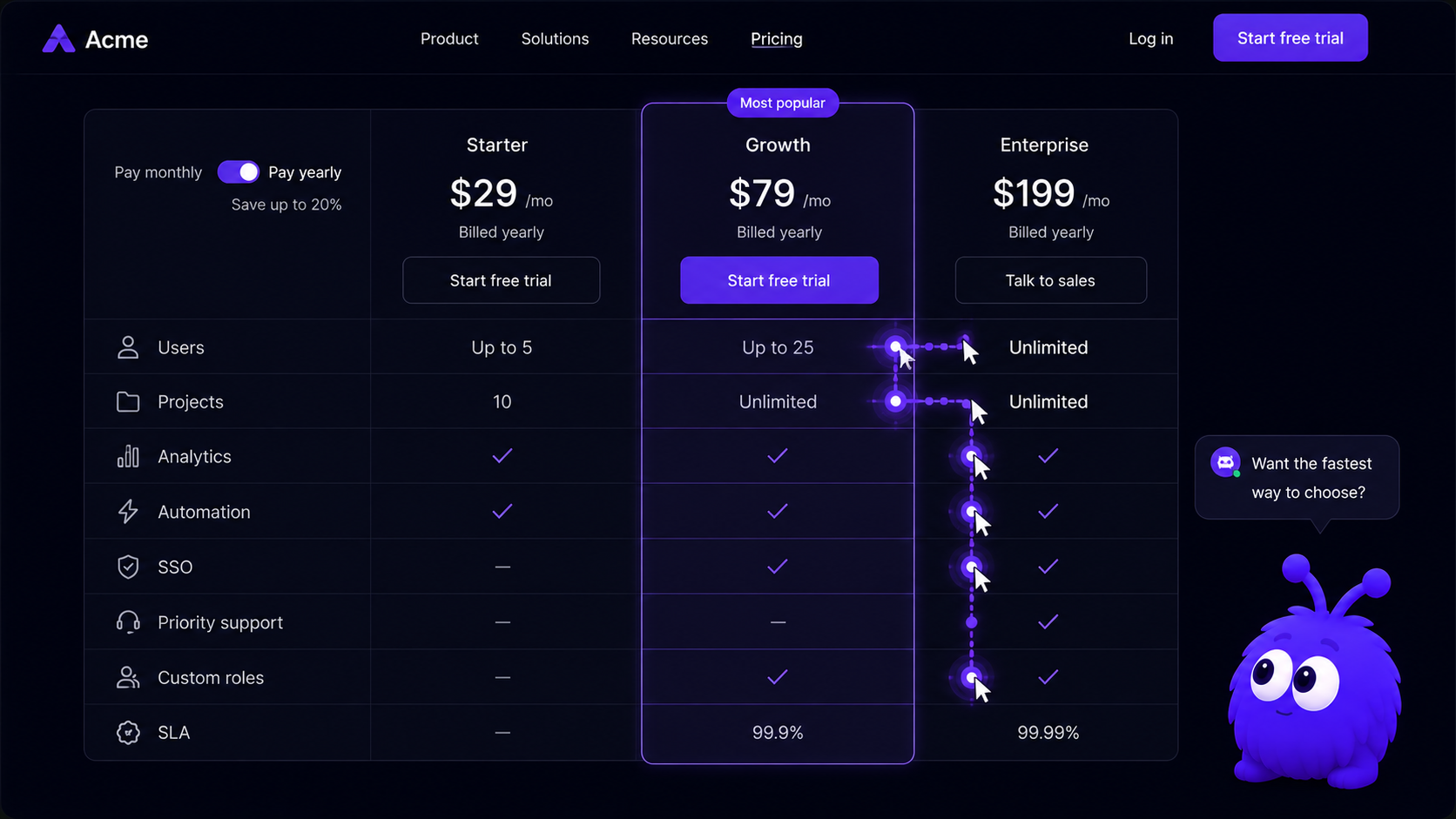
Feature-comparison hover is unique to SaaS. Most marketing sites have a tier-comparison table; the cursor traversal across that table is one of the highest-value signals available. A visitor who hovers cell-by-cell on the rightmost two columns is mid-evaluation between two tiers, and the agent can surface the differentiator that matters most for their use case.
Demo-video play rewards instrumentation. Most embedded video players expose a progress event but do not feed it into the chat layer; wiring the integration is a small effort with outsized signal value.
Review-site referrer is the cheapest signal to implement and one of the most predictive. The G2 / Capterra / Trustpilot inbound visitor has already been pre-filtered through external evaluation; the proactive intervention can skip the introductory steps and propose a trial or a demo directly.
What counts as a conversion event on a SaaS site?
Three events, in approximate order of measurement difficulty:
Free trial start. Easiest to measure, fastest to attribute. The proactive intervention's job is to remove the friction before the form (no-credit-card reassurance, single-sign-on availability, "you can leave any time" language). The win is volume.
Demo request. Higher-intent, slower attribution. The proactive intervention's job is to lower the perceived commitment ("a 20-minute walkthrough, no obligation") and to surface a calendar with the next available slot inline. The win is qualified pipeline.
Paid signup. Direct revenue, but rare on a public marketing site (most SaaS funnels gate paid signup behind a trial or sales call). When it happens, the intervention is annual-vs-monthly framing, ROI calculator surface, and contract-flexibility reassurance.
The intervention library has to know which of the three is the active goal for each session. A trial-stage visitor and a paid-signup-stage visitor look similar from the outside but need very different handoffs. A good agent works out which goal is live from the page someone is on, how they arrived, and whether they have been before.
Which SaaS landing pages benefit most from proactive chat?
Proactive chat earns its place where the website is the primary decision surface. A few patterns hold up well:
- Mid-market, product-led SaaS with a free trial and a self-serve pricing page. The visitor is making the call themselves, on the page, right now. That is exactly the moment a well-timed nudge helps.
- Enterprise SaaS with sales-led pricing. Volume is lower and the conversion is a demo request rather than a signup, but each booked demo is worth far more, so the effort still pays off.
The weakest fit is freemium developer tooling with documentation-heavy traffic. Developers reading docs treat any interruption as noise, so a "need help choosing a plan?" prompt on a reference page lands badly — few things irritate a developer mid-stack-trace like a cheerful box asking if they would like to chat. Suppressing interventions on /docs/* is the fix, and it keeps the marketing pages clean.
The pattern underneath all three: proactive chat helps where the website is the decision surface, and gets in the way where the website is the reference manual for a product someone already bought.
When does proactive chat fail on a SaaS site?
Documentation interruption. Developers reading API documentation are not buying; they are working. A "need help choosing a plan?" prompt on /docs/api/auth is the wrong question for the wrong audience. The fix is route-aware triggers: allow proactive help on marketing pages, suppress it on documentation, blog posts, and the changelog. Setting up the route patterns is part of the website lead capture configuration.
Marketing-site / app conflation. A SaaS that ships the same chat widget on both app.example.com and www.example.com ends up firing prospect-stage interventions ("ready to start a trial?") to existing paying customers logged into the app. The fix is to scope the proactive trigger set to the marketing domain and run a different, support-shaped configuration on the app domain. This is configurable in the nextjs-chatbot integration guide.
A third, subtler failure: firing the trial-start intervention on visitors who have already started a trial. The visitor came back to the marketing site to read the pricing page mid-trial; offering them a trial again signals that the agent is not paying attention. The fix is session-level memory of trial state, available via the integration if the SaaS exposes a logged-in flag.
What this means for SaaS buyers picking a chat tool
If you are evaluating a chat product for a SaaS marketing site, three things separate the real options from the rest:
- Disqualify any tool that only ships ecommerce signals. A product that reads cart state and time-on-page leaves most of the SaaS signal stack on the floor. Ask explicitly about feature-comparison hover and review-site referrer.
- Insist on route-aware trigger configuration. A single global trigger set will misfire on documentation. The product needs route patterns or URL-allowlist logic at the trigger level.
- Verify the handoff design. A SaaS conversation that ends with "thanks, that helps" and no calendar or trial CTA is a dropped conversion. The product needs first-class calendar, form, and trial-link handoffs in the intervention templates.
SaaS proactive chat is not ecommerce proactive chat with the cart removed. It is a different signal stack, a different intervention library, and a different handoff. Pick the product whose SaaS configuration is documented, not the one that mentions in passing that it "also works for SaaS."
Further reading
- GuideWebsite lead capture in 2026The SaaS-side conversion definition and the form-design layer.
- GuideThe proactive-engagement referenceThe full implementation guide for the trigger stack.
- GuideNext.js chatbot integrationRoute-aware trigger configuration for SaaS marketing sites.
- BlogBehavior-triggered chat vs time-on-page chatWhy timing alone is even weaker on SaaS than on ecommerce.
Frequently asked questions
SaaS marketing sites have no cart. The conversion is a trial, demo, or paid signup, with longer attribution windows and a different signal stack — pricing dwell, comparison hover, demo-video play, signup abandonment, multi-page deep-dive, review-site referrer, return visit.
Last updated June 10, 2026.