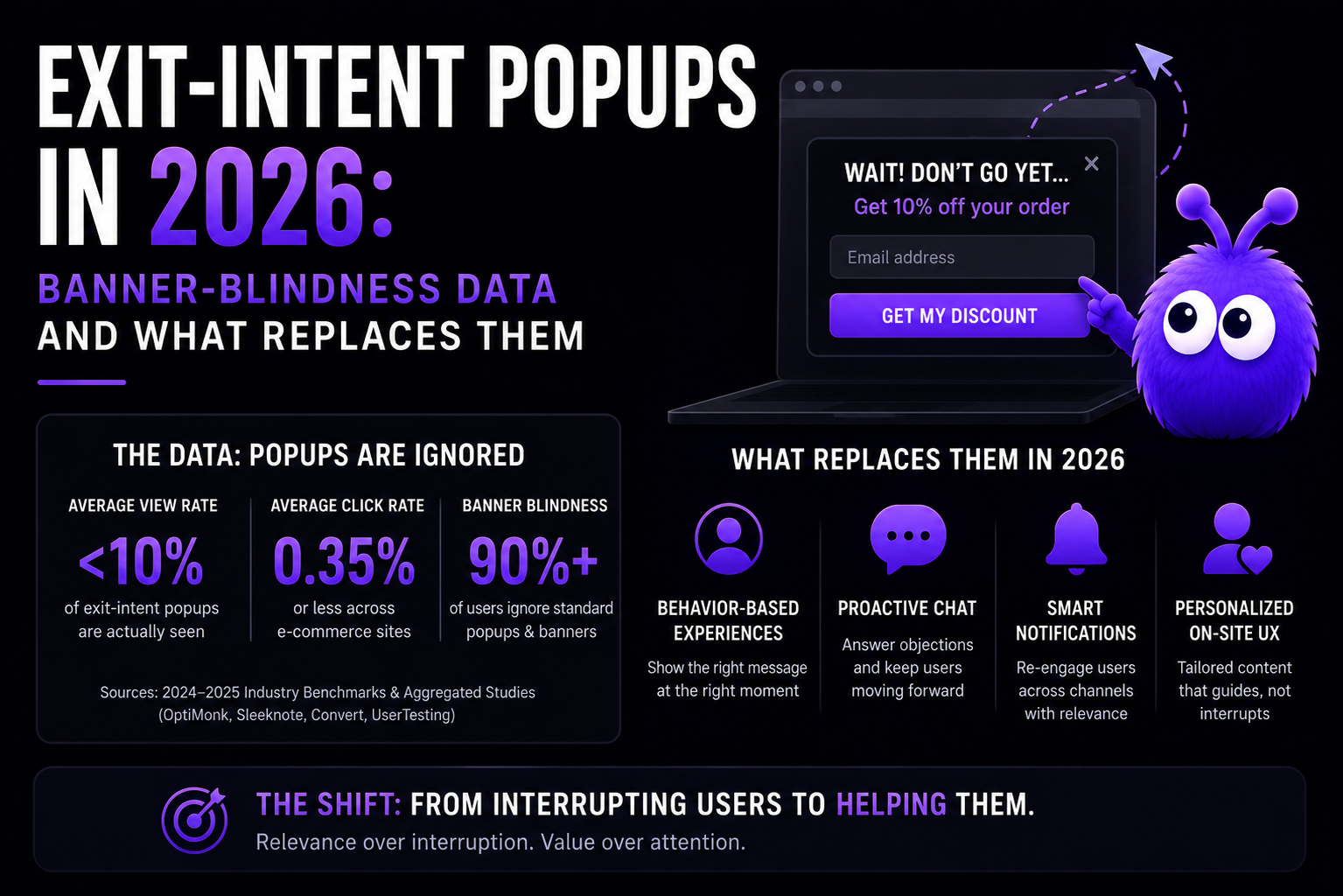
The exit-intent popup was the default abandonment-recovery surface from roughly 2014 to 2018, and it worked because it was new. Visitors had not yet learned to ignore "wait! before you go..." popups, so they read them. By 2026 the format is everywhere, and the same surface that pulled around 12% engagement a decade ago now pulls 0.4-0.9%. What replaced it is not a better popup; it is a different category, behavior-driven intervention with brand-matched continuity instead of a discount fired at the door.
This post covers the decay, why it happened, the replacement, and how to migrate off a popup you are still running.
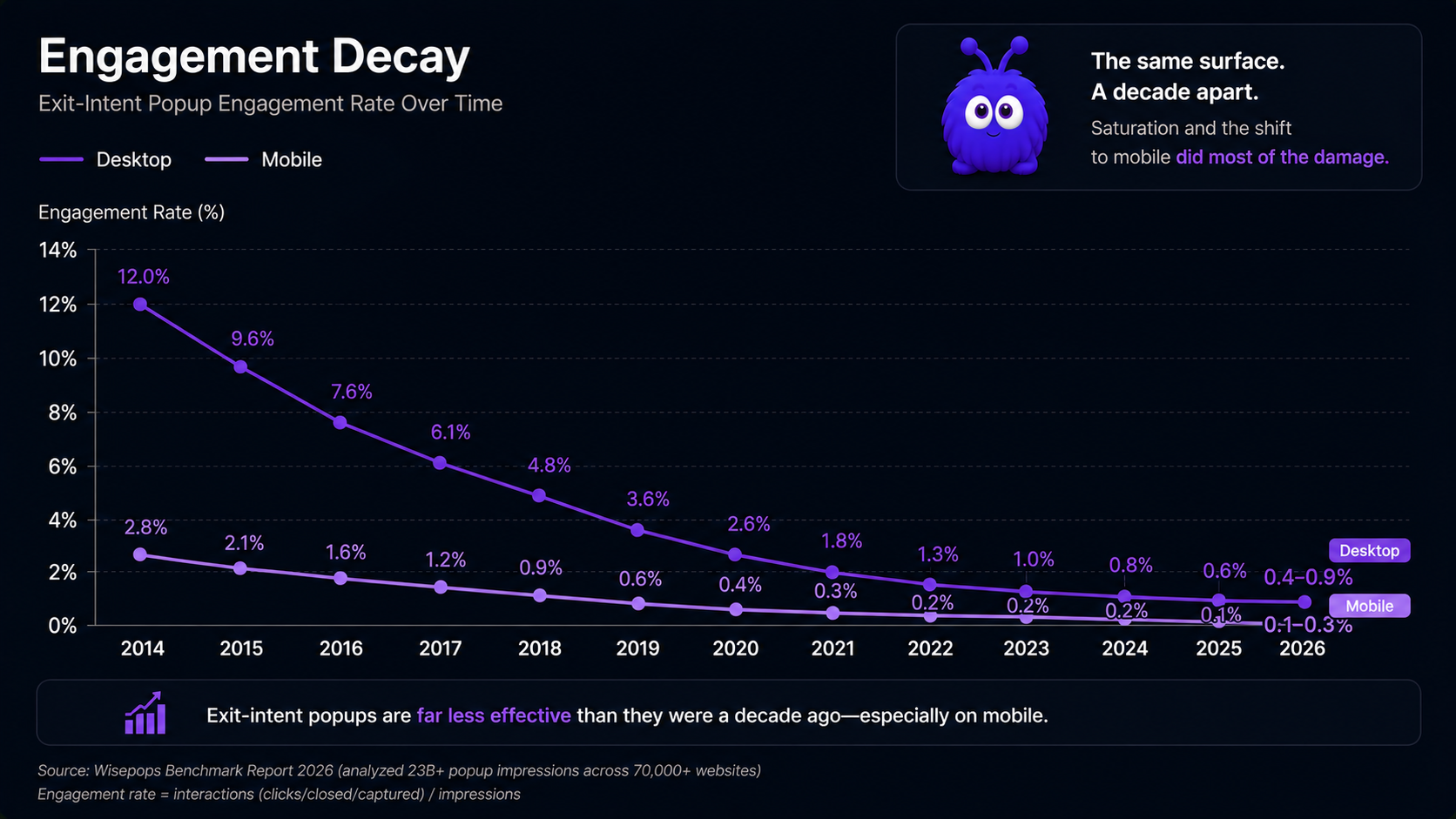
How far have exit-intent popups decayed?
Steeply. Engagement that sat around 12% when the format was novel in 2014 has fallen to 0.4-0.9% on desktop and 0.1-0.3% on mobile in 2026. The mobile line sits well below desktop, and that gap is structural rather than something a better design fixes, which is the next section.
Why have exit-intent popups decayed?
Three structural reasons.
Format saturation. Visitors have seen thousands of exit-intent popups across the web. The format now triggers a pattern-recognition response that files it as "not useful," so the eye never registers the content and the dismiss is automatic.
The shift to mobile. Mobile traffic share went from 51% in 2018 to 73% in 2026. Exit-intent detection is harder on mobile, where there is no cursor, so the false-positive rate is higher and engagement is structurally lower. The web's center of gravity moved to a context where exit-intent was always weak.
Discount fatigue. The 2014 popup offering 10% off felt like a one-time opportunity. The 2026 visitor expects discounts everywhere, so the offer has no surprise value, and some visitors actively wait for the popup to claim the discount, effectively teaching shoppers to loiter by the exit like gulls near a chip shop, which trains adversarial cart-abandonment behavior.
What replaces the exit-intent popup?
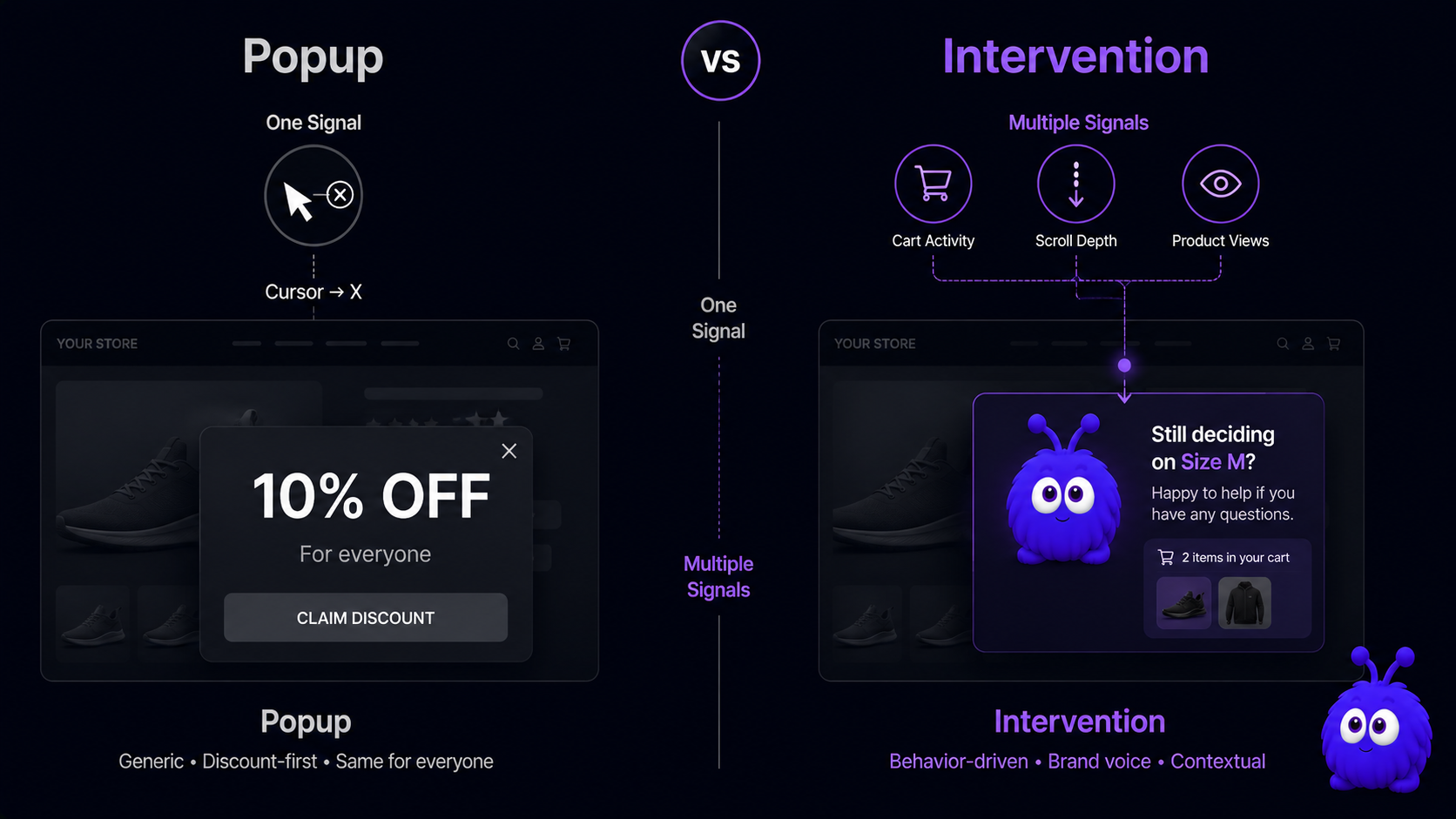
Behavior-driven, multi-signal intervention with a brand-matched continuity surface. The components:
- A multi-signal trigger. Not just "cursor moved toward the top of the viewport," but that combined with cart state, dwell time, and visit context. It fires on a much more selective cohort than exit-intent alone.
- A brand-matched mascot. It replaces the generic popup format with a character that is unmistakably the brand's, which defeats banner blindness because the format is not a saturated pattern.
- A contextual response. It surfaces something specific, your cart has X, the shipping threshold is Y, the size you viewed is back in stock, rather than a generic discount.
- Cooldown and throttling. It does not fire every visit; cross-session throttling avoids the always-there pattern that wore exit-intent popups out.
The combined system performs differently from a popup not because it is more aggressive but because it is more selective and more contextual.
How does the replacement compare?
The replacement fires far less often than a popup, engages a much higher share of the people it does reach, and converts better when it does, because it shows up at a more relevant moment with a more relevant message. The headline is not that it shouts louder. It is that it speaks up rarely and on point, which is exactly what a saturated popup cannot do.
When exit-intent popups still work
Three cohorts where the format still produces meaningful lift:
First-time visitors to small or specialty stores. People who have not been worn down by thousands of these popups, often older demographics or specific geographic markets, still respond, with engagement around 3-7% in this cohort. Bounded, but real.
New product launches with genuine deadline urgency. "Last day for the launch discount" with a real deadline beats the rolling-discount popup, because visitors recognise real urgency.
Travel and hospitality with comparison shoppers. Visitors comparing flights or hotels often abandon mid-comparison, and an exit-intent popup framed as "save this search" can capture that cohort.
For most ecommerce in most categories, the popup is not worth the implementation cost. For these specific cohorts, it can still earn its place.
How do I migrate off exit-intent popups?
Three steps:
Add the replacement intervention. Install Yokaify (or an equivalent) running in parallel with the popup. The two do not conflict, because they fire on different signals.
Run a 30-day holdout comparison. Three cohorts: treatment with both popup and intervention, treatment with the intervention only (popup disabled), and a holdout with neither. Measure conversion per cohort.
Decommission the underperformer. For a few stores, keeping the popup as a tertiary fallback for specific cohorts makes sense. Most find it cleaner to remove it entirely.
What does running a popup actually cost?
Even when a popup produces marginal lift, the costs add up:
Page weight. Popup libraries (OptinMonster, Privy, Sumo) add 30-90 KB of JS plus CSS, and the CWV impact is real, LCP +50-150ms when eager-loaded.
Mobile intrusion. Mobile exit-intent triggers are noisy, and a false-positive popup on a legitimate scroll-to-top feels disrespectful.
Accessibility burden. Popups need keyboard navigation, screen-reader announcements, and focus management. Many implementations skip all three and ship a WCAG-failing surface.
Brand-safety risk. A generic popup format inherits the negative associations of every low-quality popup elsewhere on the web.
The replacement carries less cost on each of these: it is integrated with a chat surface the brand controls, adds no separate library, and inherits accessibility from the chat tool's audit pattern.
What this means for buyers
Three takeaways:
- Stop treating the popup as your primary recovery surface. Its engagement has decayed to the point where the UI cost usually exceeds the lift.
- Default to behavior-driven intervention as the replacement. The category is structurally more effective, cheaper to implement, and lower brand-safety risk.
- Keep the popup only for the cohorts where it still works. Travel comparison-shoppers, first-time visitors to specialty stores, real-deadline launches. Most stores have none of these.
The exit-intent popup is a 2014 pattern that has aged out. What replaces it is not a slightly better popup; it is a different category entirely.
Further reading
- ToolCart abandonment calculatorModel the recovery upside.
- GlossaryExit-intentThe behavior signal underlying the popup pattern.
- GlossaryBanner blindnessThe mechanism behind the popup decay.
- BlogCart abandonment psychology 2026The cohort decomposition.
- BlogBehavior-triggered vs time-on-page chatTrigger-quality dimension.
- GuideThe 2026 cart-recovery playbookThe full recovery framework.
Frequently asked questions
Mostly no. Engagement decayed to 0.4-0.9% on desktop and 0.1-0.3% on mobile. The UI cost usually exceeds the lift.
Last updated June 10, 2026.