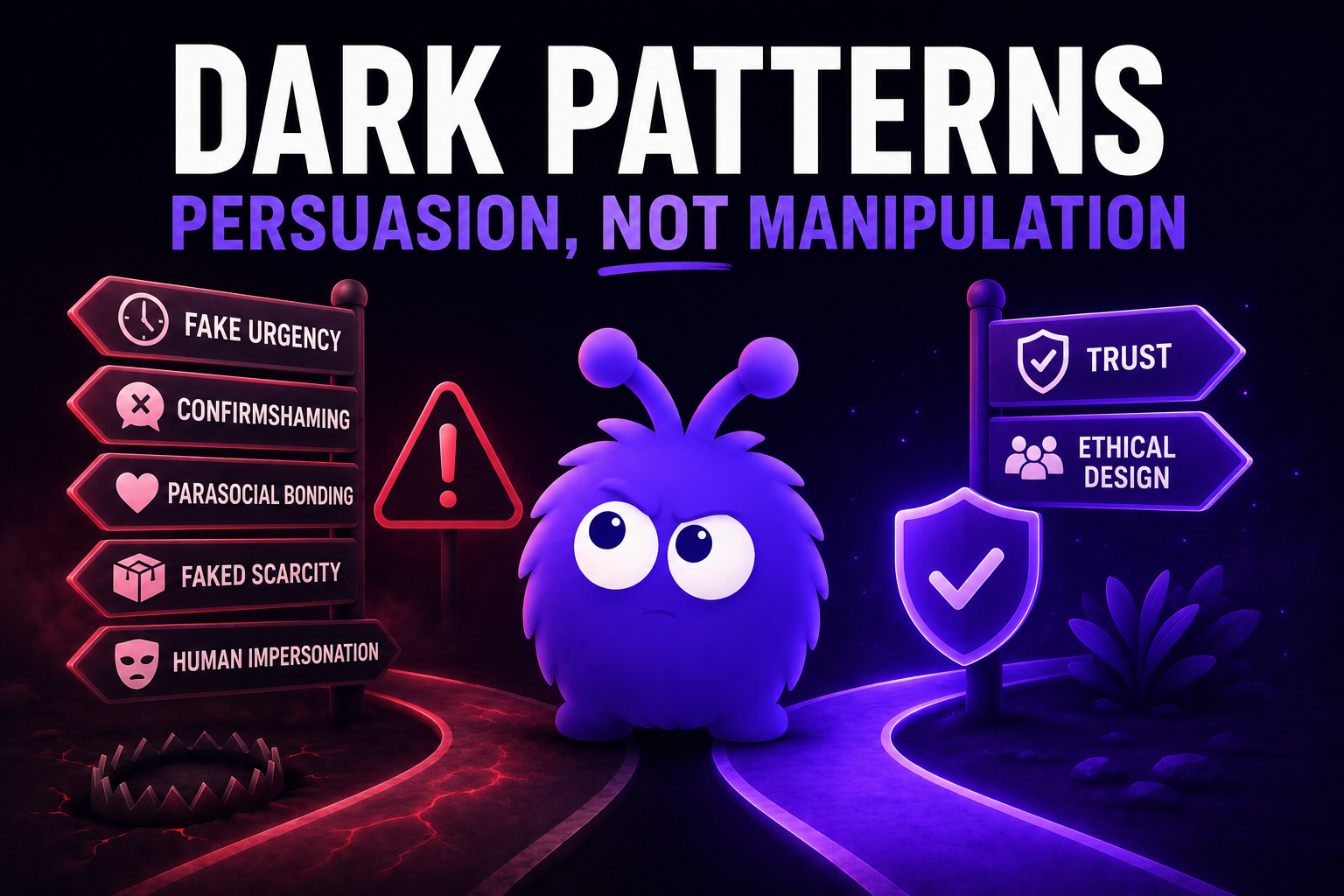
The AI-mascot category in 2026 is big enough that the bad implementations are easy to spot. A mascot that nudges too hard, one that fakes emotional warmth, one that invents scarcity — each buys a short-term lift and a long-term brand cost the operator does not notice until a returning-visitor cohort goes quiet or a regulator opens a file.
This article names five patterns that turn up in the wild, anchors them against 2026 regulation, and describes the refusal patterns that keep a mascot on the persuasion side of the line.
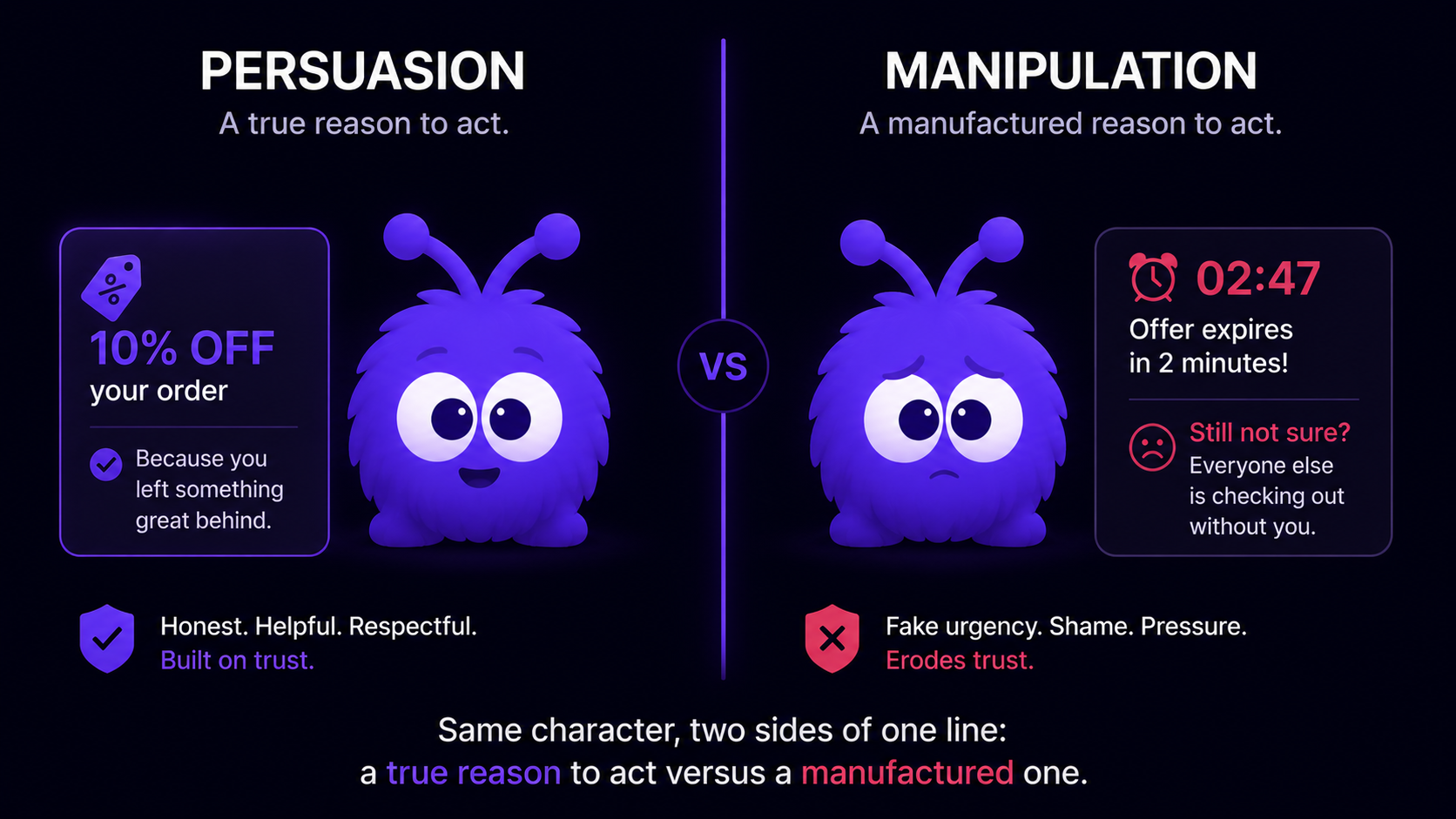
What separates persuasion from manipulation?
A working definition: persuasion gives the visitor a true reason to act; manipulation gives a reason that is not true, exploits a cognitive shortcut without disclosure, or makes the alternative unreasonably costly to choose.
Three tests applied at template intake:
- Truth test. Is the claim accurate? Free shipping at $80 is true if the threshold is real. "Only 3 left" is true if and only if the inventory feed says so.
- Disclosure test. Would the visitor object if they understood what was happening? A behavior-triggered intervention disclosed as such passes; one disguised as a "real-time customer message" fails.
- Symmetry test. Is refusing the offer as easy as accepting? "No thanks" passes; "No, I don't care about saving money" fails.
The three tests come from a synthesis of the behavioral intervention literature and the regulatory texts cited below; none of them is novel. What is new in 2026 is that regulators expect operators to apply the tests before deployment, not retroactively after a complaint.
What does 2026 regulation say about AI mascots?
Two regulatory anchors matter most for mascot operators in 2026.
UK ICO Online Choice Architecture guidance, 2026 update. The UK Information Commissioner's Office published an update to its online choice architecture guidance in early 2026 (UK ICO, 2026). The update specifically called out AI-mediated nudges as in scope of existing dark-patterns rules and required operators to maintain a written record of which behavioral interventions were tested, with what hypothesis, and what the holdout result was. The guidance does not ban persuasion; it requires the persuasion to be documentable.
FTC Endorsement Guides, revised 2024. The US Federal Trade Commission revised its endorsement guides in 2024 (FTC, 2024). The revision explicitly extended the rules to AI-generated endorsements and AI-generated reviews. A mascot that says "customers love this" without those customers existing is now an endorsement-rule violation regardless of whether the mascot is "obviously" an AI to a sophisticated reader.
The two anchors do not exhaust the regulatory surface — state-level US action and EU AI Act provisions also apply — but they are the two that come up most in compliance reviews and that drive the largest share of template-design decisions.
What are the five patterns that cross the line?
| Pattern | How it manipulates | Failed test | Regulatory exposure | The clean alternative |
|---|---|---|---|---|
| False urgency | Countdown timer with no real deadline; "selling fast" with no inventory drop | Truth | UK ICO 2026 dark-patterns; FTC unfair-practice | Time-bound offer tied to a real cutoff named in the message |
| Confirmshaming | Refusal worded to shame ("No, I don't want to save money") | Symmetry | UK ICO 2026 dark-patterns | Neutral refusal with the same visual weight as the acceptance |
| Parasocial bonding | Mascot claims emotion it cannot have ("I missed you", "I hope you come back") | Disclosure | FTC 2024 deceptive practices; UK ICO 2026 | Neutral functional language ("Welcome back" without manufactured emotion) |
| Dark-pattern scarcity | Stock counts not tied to inventory; "X people viewing" with no tracking source | Truth | UK ICO 2026; FTC 2024 substantiation rule | Inventory-feed-connected counts; surface only when threshold is real |
| Human impersonation | Mascot speaks as if human; hides AI nature when asked | Disclosure | FTC 2024 endorsement guides; EU AI Act 2026 | Welcome line discloses AI status; direct question gets a direct answer |
Three of the five patterns are old dark-patterns dressed in mascot clothing — false urgency, confirmshaming, faked scarcity were on the Brignull dark-patterns list before AI mascots existed. The two new patterns are mascot-specific: parasocial bonding and human impersonation.
Parasocial bonding is the mascot equivalent of a salesperson manufacturing a friendship to close. The character claims to "miss" the visitor, to "hope" they come back, to "love" helping. The visitor's emotional response is real; the mascot's is not. The asymmetry is the manipulation. The disclosure test fails: a visitor who understood the mascot has no internal state would not consent to the framing.
Human impersonation is the failure to identify as AI when asked, or affirmative deception ("I'm one of the team here"). The 2024 FTC revision and the EU AI Act 2026 both treat this as a transparency violation, not just a brand-tone choice. A mascot can have a personality without claiming a body — charm is allowed; a fabricated backstory and a fake desk photo are not.
How does a pre-cleared intervention library enforce the line?
Yokaify's intervention library is reviewed against the three tests and the two regulatory anchors before any template is included. Three enforcement mechanisms operate together.
Template review at intake. Each template names which signal it responds to, which friction point it addresses, and which evidence supports any claim it makes. Templates that cannot point to evidence — a generic "limited time offer" with no real time bound, a "popular with shoppers like you" with no clustering output — are rejected at intake.
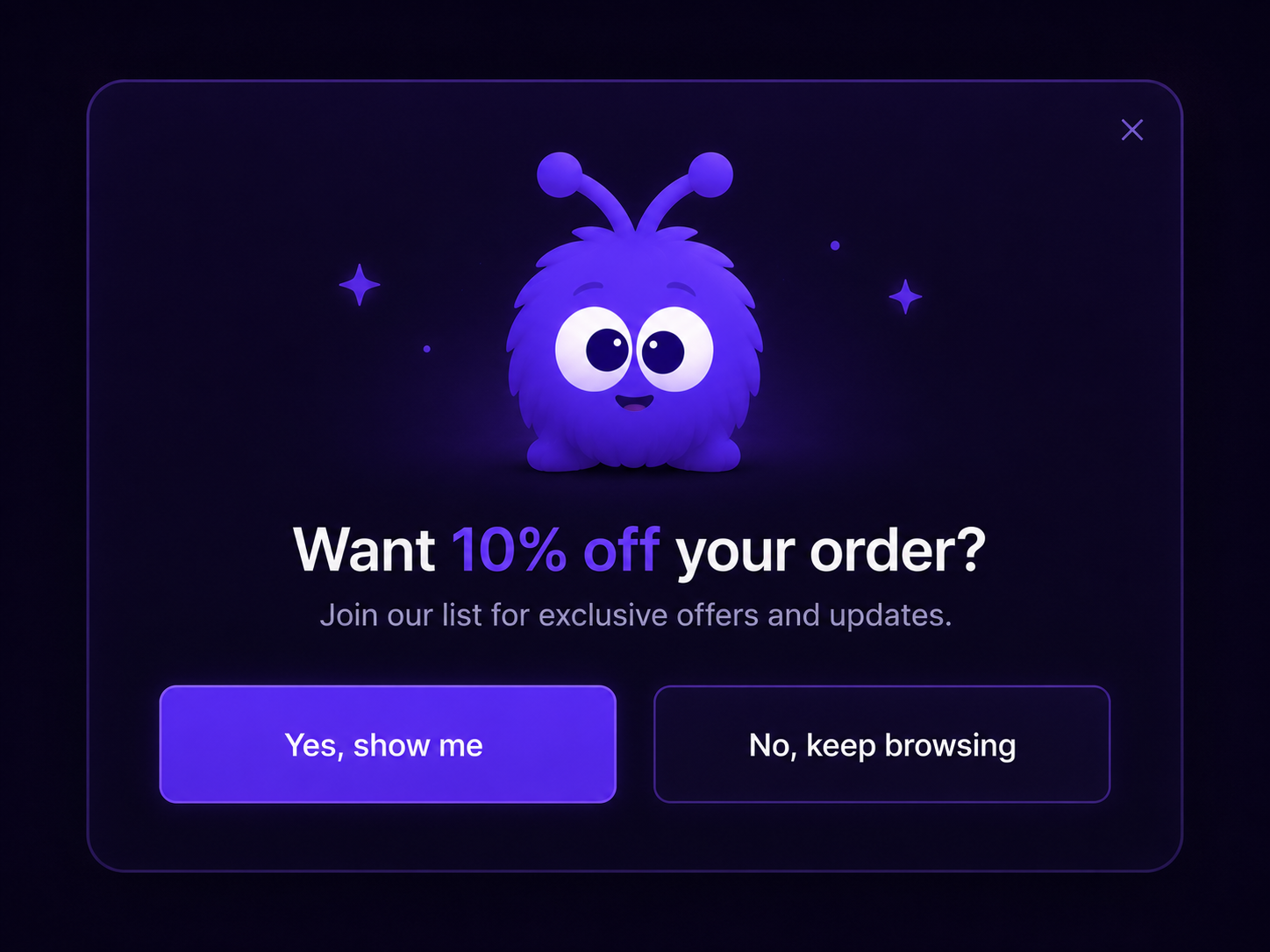
Paired refusal patterns. Every intervention has a paired refusal ("No, I'd rather keep browsing", "Not now") that is symmetric to the acceptance — same visual weight, same proximity, same neutral wording. A refusal cannot be smaller, grayer, or worded to shame. The symmetry is checked at the design-system level, not template-by-template.
Disclosure surface. The mascot identifies as AI in the first message of every conversation and on any direct question about its nature. There is no "human mode" toggle. The disclosure is short — one line — and is part of the proactive chat playbook trigger pattern, not an extra modal.
The library is not a substitute for operator judgment. Operators still pick which templates to enable for their store and audience, and they still write the substantive copy inside structured slots. What the library does is remove the easy-to-deploy versions of the five patterns from the operator's surface entirely.
What does enforcing the line cost?
Three honest costs.
A short-term revenue tradeoff. Manipulation patterns do produce a bump, so removing them can look like leaving money on the table at first. The bump is borrowed, though: false urgency and faked scarcity train returning visitors to ignore future messages, which erodes the engagement base over the following weeks. The clean version trades a fast spike for a base that keeps responding.
Intervention-design time goes up. Writing a template that names a true reason takes longer than writing one that fakes urgency. The investment compounds because the library is reusable, but the per-template cost is real and worth budgeting for.
Someone has to own the line. Enforcing it requires a real person — a compliance reviewer or content owner — to run template intake. Without that role, the policy decays into a marketing claim. With it, it compounds into a brand asset.
What this means for buyers picking a mascot product
Three concrete shifts when evaluating an AI-mascot vendor:
- Ask which regulatory anchors the vendor's intervention library is reviewed against. "Compliant" without a named anchor is a marketing claim. UK ICO 2026 and FTC 2024 are the minimum two; add EU AI Act 2026 if you ship in Europe.
- Inspect the refusal patterns, not just the acceptance flow. A vendor that lets you write a confirmshaming refusal will let your operators write one. The vendor's defaults reflect their floor.
- Verify the disclosure surface. Type "are you a real person?" into the demo. The answer should be direct. If the mascot dodges, the vendor has shipped human impersonation as a feature.
The shorthand: a mascot earns the right to persuade by passing the three tests. A vendor earns trust by enforcing them at the template layer.
Further reading
- GuideThe website-mascot strategy playbookThe 2026 implementation framework, including the compliance section.
- BlogProactive chat compliance in 2026The companion piece on the regulatory landscape for chat triggers.
- BlogThe proactive-chat psychology backboneThe behavioral-economics framing that pre-empts manipulation patterns.
- GlossaryBehavioral interventionThe category these templates belong to.
Frequently asked questions
Three tests: truth (is the claim accurate), disclosure (would the visitor object if they understood), symmetry (is refusing as easy as accepting). Failing any of the three has crossed the line.
Last updated June 10, 2026.