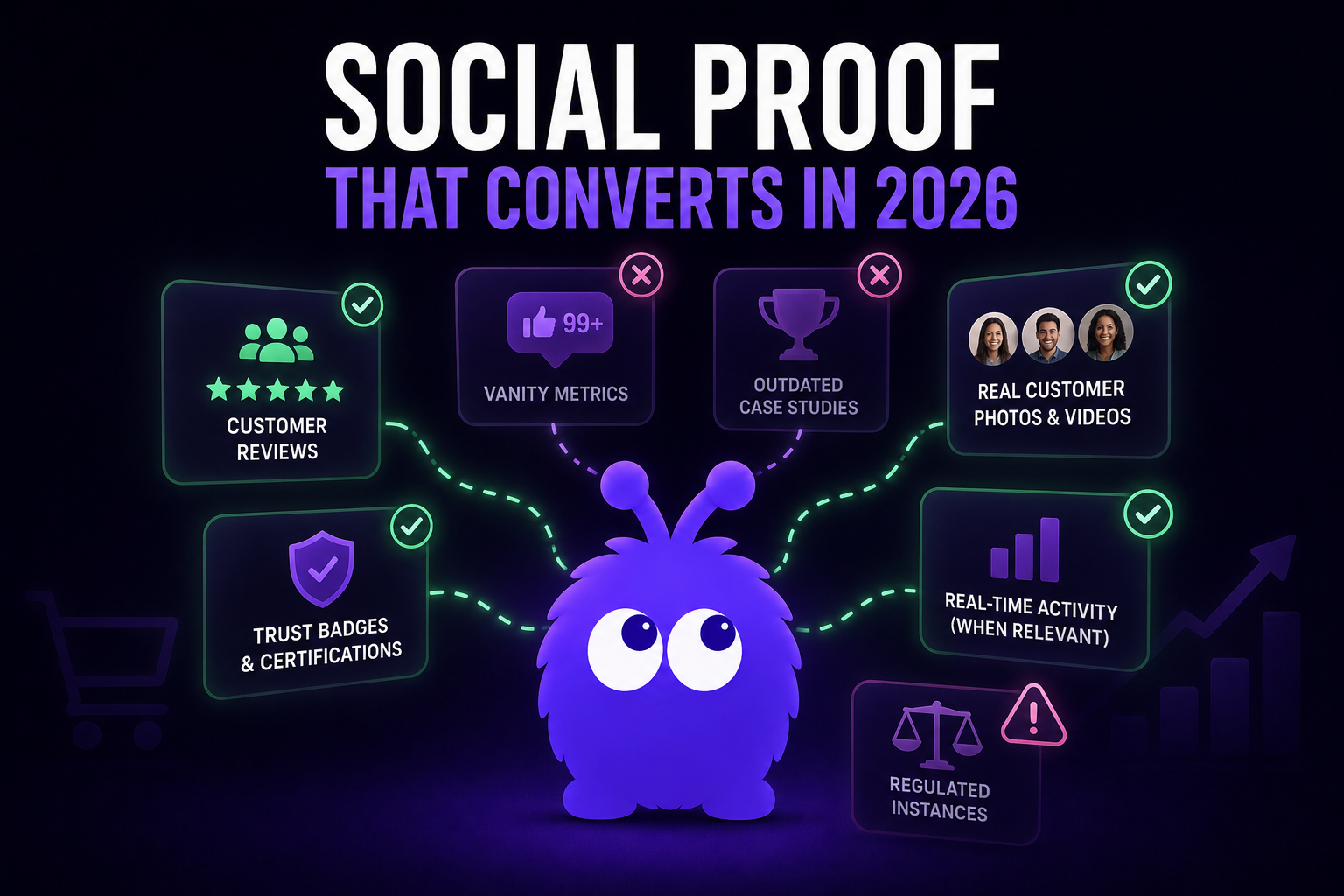
Few CRO tactics have been recommended as often, or applied as carelessly, as social proof. The 2018 advice treated every form of it as a guaranteed win. The 2026 picture is more mixed: some forms still produce reliable lift, others have worn down into background noise, and a handful are now regulated.

What forms of social proof actually move conversion in 2026?
| Form | Typical CVR lift | Verticals with largest impact | Status in 2026 |
|---|---|---|---|
| Customer count claim ("1M+ customers") | +0.5-2% | B2B SaaS, established brands | Specificity-dependent |
| Detailed text reviews (long-form) | +0.5-1.5% | Electronics, home, B2B | Reliable; reads as genuine |
| Recent-purchase ticker ("John just bought") | +0.0-0.3% | None reliably | Banner blindness; regulated |
| "X people viewing now" | +0.0-0.4% | Some flash-sale contexts | Banner blindness; often fabricated |
| Fake / fabricated reviews | Negative | None | Regulated under FTC 2024 |
The pattern: forms that signal genuine, third-party, verifiable trust still work. Forms that visitors have learned to recognize as theater have decayed. Forms that cross into fabrication are now regulated.
Why do star ratings still work in 2026?
The star rating is the single most-trusted social-proof element in 2026 because it carries three signals: a quality assessment (the average), a sample-size validation (the count), and an honesty marker (a real average is rarely 5.0).
The Baymard Institute 2026 panel measured CVR with and without star ratings displayed.
Visitors trust averages between 4.0 and 4.8 with high counts more than 4.9-5.0 averages with low counts. The 4.9 with 12 reviews reads as new or curated; the 4.3 with 1,500 reviews reads as a representative cross-section. Three implementation rules: show the count next to the average ("4.4 (1,247 reviews)" beats "4.4 stars"); link the average to filterable reviews; surface the rating distribution. For implementation patterns, the product page optimization coverage of the reviews row goes deeper.
Why are user-generated photos disproportionately effective on apparel and home?
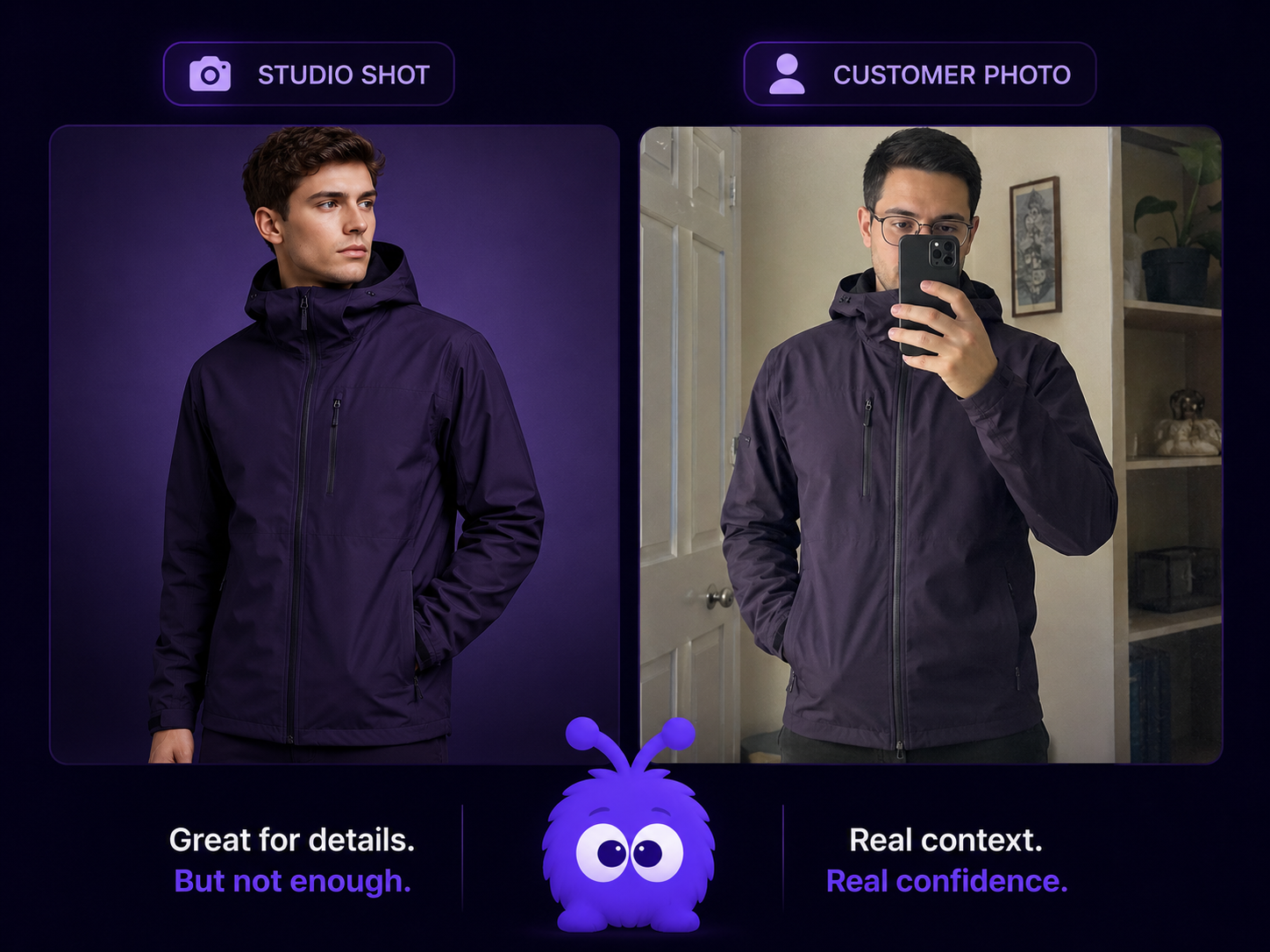
The UGC gallery — a section showing customer photos of the product in use — produces a 3-7% absolute CVR lift on apparel and home (Baymard Institute, 2026). The same gallery on electronics and food produces 1-3%. The vertical split tracks where "how does this actually look" anxiety lives.
On apparel, the brand photo shows a model in studio lighting; the customer photo shows the same item on a real body in normal lighting — the visitor's "will this fit me" question is answered in a way the brand photo cannot. On home and furniture, the customer-living-room photo answers "will this fit my space and my style". On electronics and food, the spec is the spec; customer photos add some trust but answer a smaller question.
What's the regulatory line on fake social proof?
Two pieces of regulation matter in 2026, and both have produced settlements.
The FTC 2024 endorsement guides revised the 2009 version on three points (FTC, 2024): endorsements, reviews, and testimonials must reflect genuine experiences (fabricated reviews are subject to civil penalties up to $51,744 per violation under the 2023 Rule on Use of Consumer Reviews); material connections (paid endorsements, free product, family relationship) must be disclosed clearly; use of consumer reviews must not suppress negative reviews or selectively display only positive ones.
The ICO 2026 dark-patterns guidance and the EU Digital Services Act 2024 implementation classify fabricated scarcity, fabricated recent-purchase tickers, fabricated "X people viewing now" counters, and pre-checked subscription opt-ins as deceptive design subject to enforcement (ICO, 2026; EU DSA, 2024).
The regulation is real and is being enforced. Three FTC settlements involving fabricated reviews settled in 2024-2025 with combined penalties exceeding $20M (FTC press releases, 2024-2025). The cost of running fabricated social proof is no longer "a brand-trust risk"; it is a measurable compliance liability. Fabrication is no longer a CRO trade-off; it is a regulatory exposure.
Recent-purchase tickers: what changed since 2018?
The 2026 data has reversed.
The Wynter 2026 panel reported (Wynter, 2026): 71% of shoppers visually skip recent-purchase tickers within 5 seconds of page load; 12% report negative trust impact; 8% report having seen the same pattern across multiple unrelated sites and now associate it with manipulation. The mechanism is banner blindness compounded by skepticism — the pattern was novel in 2018, ubiquitous by 2024, suspicious by 2026. By now the imaginary shopper in those "someone just bought this" tickers has racked up more purchases across more unrelated stores than any actual human could manage in a lifetime.
Chat-surfaced reviews convert better on first-time visitors. When a proactive intervention reads "150 customers bought this in the last month — would it help to see what they said?" and links to the reviews, the engagement-to-conversion rate runs markedly higher than for visitors who scroll to the reviews unprompted. Chat-driven framing makes the social proof relevant.
Chat-surfaced UGC underperforms static UGC. Photos are hard to display in a chat surface. UGC works in galleries, not in conversations.
Chat does not rescue fabricated social proof. A chat intervention surfacing a fake recent-purchase ticker is the same fabrication, surfaced through chat. The Yokaify configuration explicitly does not synthesize purchase events; it only surfaces real ones from the order stream.
What this means for an operator in 2026
Lead with star ratings, plus the count and the distribution. It is the single most reliable social-proof element in 2026, and the legal exposure is zero. If a product has fewer than 25 reviews, seed the review pipeline first (a post-purchase email, the post-purchase survey builder) before reaching for anything decorative.
Drop the recent-purchase ticker and the "X viewing now" counter. They do not lift CVR, they erode trust with a meaningful share of visitors, and they put the brand in front of FTC and ICO enforcement.
Then put real effort into UGC moderation and submission. The largest social-proof lift on apparel and home lives there, and it compounds over time.
The shorthand: real social proof works, fabricated does not, and the regulatory line moved in 2024-2026 to make the shortcut more expensive than the work.
Further reading
- GuideThe 2026 CRO playbookWhere social proof fits in the broader CRO context.
- BlogProduct page optimizationWhere star ratings and reviews row sit on the PDP.
- BlogThe proactive-chat psychology backboneWhy social proof maps to the confidence friction point.
- BlogSession vs visitor memoryRecognising returning vs first-time visitor cohorts.
- ToolPost-purchase survey builderSeed the review pipeline that powers the star rating.
Frequently asked questions
FTC 2024 endorsement guides ($51,744 per violation under the 2023 Rule), ICO 2026 dark-patterns guidance, EU DSA 2024. Real settlements; not theoretical.
Last updated June 10, 2026.