If you are choosing a runtime for an animated character in 2026, you will land on Rive versus Lottie. The shorter /vs/ page is the at-a-glance version; this one goes deeper, to the level engineers actually decide on.
There is no universal answer. Each runtime has a band where it clearly wins, and a fan club that insists the band is the whole stage. The rest of this piece names those bands and shows the numbers behind them.
What is the headline difference between Rive and Lottie in 2026?
State machines. Rive 2026 ships a built-in state machine (Rive runtime docs, 2026): a character has named states (idle, attentive, speaking, celebrating), named inputs (boolean, number, trigger, listener), and transition rules between states triggered by input changes. The state machine runs entirely inside the Rive WASM runtime; the engineer drives it by writing to inputs.
Lottie animates a fixed timeline. The runtime plays a sequence of keyframes from start to end, optionally looping. To get reactive behavior, the engineer plays different segments of the timeline based on app state, or swaps between multiple Lottie files. Both patterns work but neither is a state machine — there is no native concept of named states with conditional transitions. Lottie 5.x added "interactivity" through the LottieInteractivity library (Lottie docs, 2026), but it is a layer on top of timeline animation rather than a state machine in the Rive sense.
For a marketing-page hero animation, the difference does not matter. For a mascot driven by behavior signals (hover, cart fill, agent speaking, conversion celebration), the state machine is the feature you cannot do without.
How do the bundle weights compare?
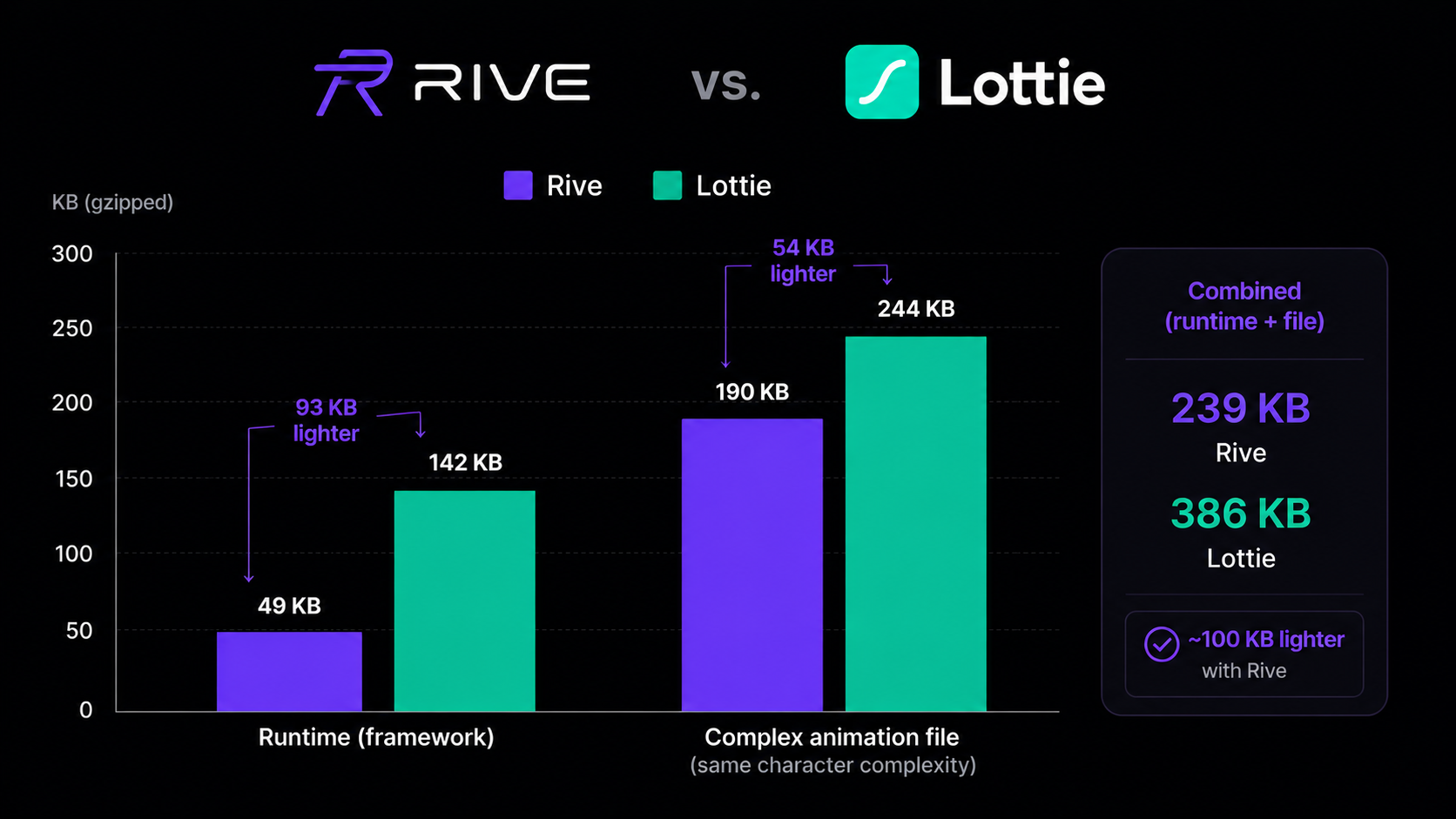
The runtime delta is 40-50KB. The animation-file delta varies independently and depends on the design.
| Component | Rive (2026) | Lottie (2026) | Delta | Notes |
|---|---|---|---|---|
| Runtime — compressed | ~80-100KB | ~130-150KB | Rive lighter by 40-50KB | @rive-app/react-canvas vs lottie-web |
| Runtime — uncompressed | ~280-340KB | ~480-560KB | Rive lighter by 200KB | Source: published 2026 docs |
| Simple mascot animation file | ~40-80KB | ~30-60KB | Rough parity | Both compress vector well |
| Complex character animation file | ~80-150KB | ~120-220KB | Rive lighter by 30-70KB | Rive shape primitives more compact than Bodymovin |
| Total budget (runtime + complex file) | ~160-250KB | ~250-370KB | Rive lighter by ~100KB | The combined budget is the meaningful metric |
The runtime numbers are from published 2026 documentation (Rive runtime docs, 2026; Lottie docs, 2026). The animation-file numbers are typical ranges from the Yokaify mascot library and equivalent Lottie reference files (May 2026). Real numbers vary with design complexity; the relative ordering is stable.
The combined budget is the metric that actually matters at the frontend-performance-ecommerce site-wide CWV gate. Rive lands ~100KB lighter for the same character complexity. On a marketing page with an LCP target under 2.5s on slow 4G, the 100KB delta is enough to move LCP by a meaningful margin at the gate.
Is Lottie's ecosystem advantage real?
Yes, and it is worth naming honestly. Lottie has been the industry default since 2017 and accumulated three real advantages.
After Effects export. Lottie was designed to consume After Effects output via the Bodymovin plugin. Motion-graphics designers who work in After Effects can ship to web, iOS, and Android without re-authoring. Rive's editor is purpose-built for character animation, but it is a different tool — a designer migrating from After Effects has a learning curve.
LottieFiles library. LottieFiles hosts tens of thousands of pre-made animations licensed for commercial use. For teams that need an animation but do not want to build one from scratch, Lottie has a substantially deeper inventory than Rive's community marketplace.
Mobile-app integration maturity. Lottie has shipped in iOS and Android apps for nearly a decade. The runtimes are battle-tested, the rendering quirks are documented, the performance characteristics are known. Rive's mobile runtimes are solid but younger; the surface area of edge cases is smaller because the runtime is smaller.
For a team whose designers work primarily in After Effects, whose product surface is mobile-first, or who depend on pre-made animations from a library, Lottie's ecosystem advantage is real. The decision is not Rive-over-Lottie across all cases.
Why did Yokaify choose Rive specifically?
Three reasons that compounded.
State-machine reactivity. A behavior-driven mascot has to read app state and change visually in response. Rive's state machine supports that natively. The Lottie equivalent means bolting state-graph logic on top via LottieInteractivity, which adds complexity and tends to feel less responsive. For a reactive character, that pushed the decision toward Rive.
Bundle weight at the CWV gate. The post-March-2026 site-wide CWV gate effectively requires the chat surface to fit inside a 250KB budget on the marketing-page critical path. Rive at 80-100KB runtime + 80-140KB mascot file lands at 160-240KB. Lottie at 130-150KB runtime + 120-220KB animation file lands at 250-370KB. The Lottie path was tight at best, and on the heavier mascot designs the budget did not fit.
Designer toolchain match. The Yokaify mascot designs are character-system work — bones, blend states, micro-expressions, lip sync. Rive's editor is purpose-built for this. After Effects (the Lottie source) is purpose-built for motion-graphics work; character animation in After Effects is possible but requires plugins and adapters. In practice, character work went noticeably faster on the Rive path.
The three reasons are not independent — bundle weight, reactivity, and toolchain all point at character-driven UX as Rive's specific band. For a marketing-only animated illustration, none of the three would have mattered, and Lottie would have been a reasonable choice.
When should a team pick Lottie instead?
Five legitimate reasons to pick Lottie over Rive in 2026.
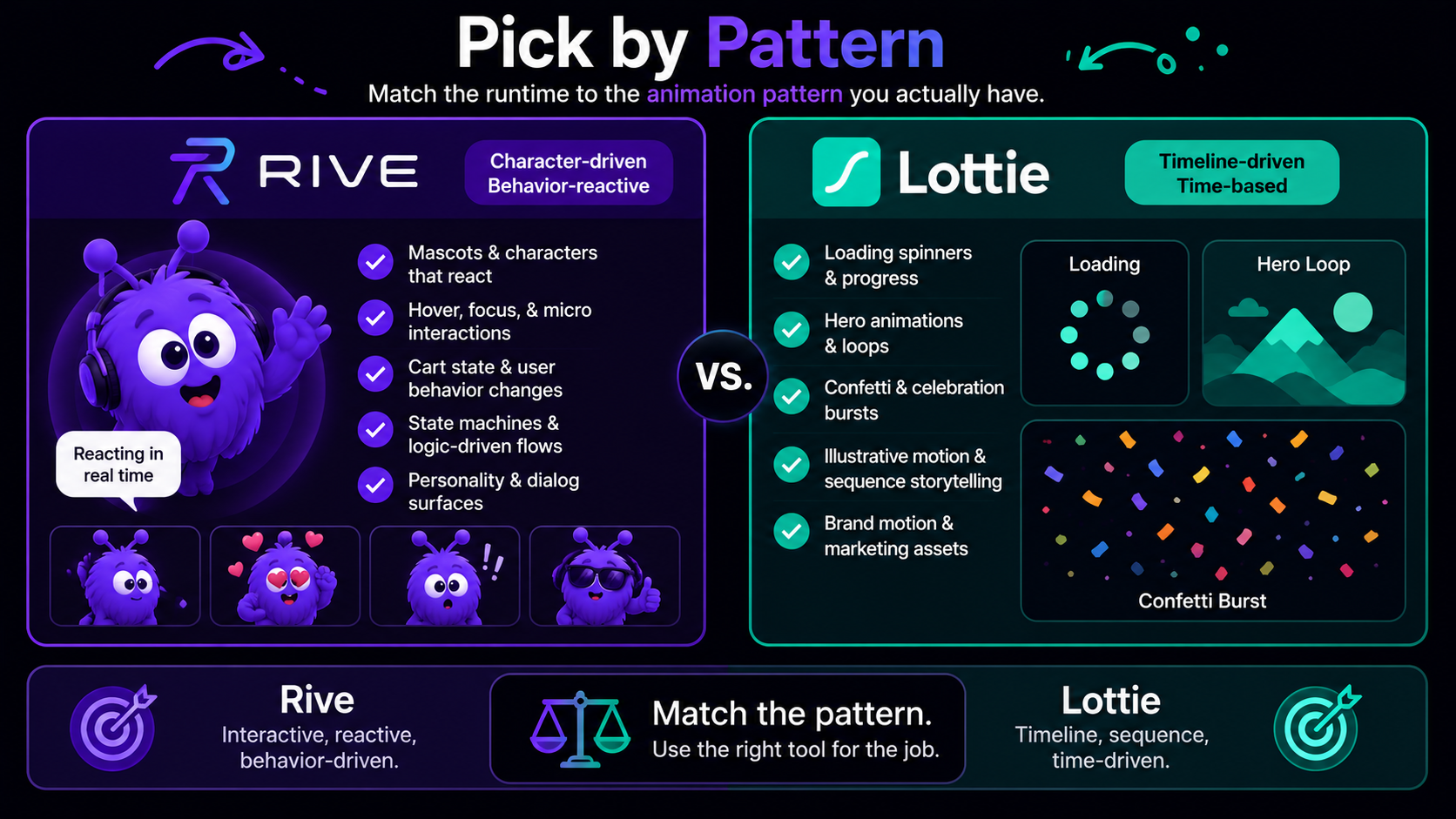
Timeline-only animation. A loading spinner, a hero illustration that animates on page load, a confetti burst on form submission. None of these need state machines. Lottie's ecosystem advantage and pre-made library make it the faster path.
After Effects-native design team. A team whose designers are deep in After Effects and whose pipeline is set up for Bodymovin export will ship faster on Lottie. The learning curve to switch a senior motion designer to Rive is non-trivial; if the designer is the bottleneck, defer to their tooling.
Mobile-app-first product. Lottie's iOS and Android runtimes have been in production for ~9 years; Rive's are ~3 years. For a product whose primary surface is a native mobile app and whose web surface is secondary, Lottie's mobile maturity is the stronger bet.
Need for an animation library. LottieFiles' inventory of commercial-licensed pre-made animations is unmatched. For onboarding sequences, success states, and decorative motion that does not need brand-specific design, Lottie shortens the path materially.
Existing investment. A team with a Lottie pipeline, a designer comfortable in After Effects, and existing animation files should not switch to Rive without a forcing reason. The migration cost is real; the runtime delta on a marketing-only animation is small enough not to justify the switch.
The band is clear enough: Rive for character-driven, behavior-reactive surfaces, and Lottie for timeline and decorative motion. Neither is universally correct.
What about accessibility?
Both runtimes can be wrapped to respect prefers-reduced-motion — neither does it by default. The wrapping is the implementation cost, and the implementation is similar across the two runtimes.
The key check is the same: window.matchMedia('(prefers-reduced-motion: reduce)').matches on mount. If true, render a static fallback. Rive teams use a static SVG of the idle frame; Lottie teams use a poster image or the first frame of the animation. The output is equivalent; the wrapping pattern is the same.
The accessibility floor is documented in the animated-character-vs-static-avatar piece. The Yokaify wrapper, generated by the /tools/nextjs-rive-wrapper tool, includes the reduced-motion fallback by default; equivalent Lottie wrappers exist but are less standardized.
What this means for buyers picking an animation runtime
Three checks before you commit.
- Name the surface and the behavior. If the animation has to react to app state — hover, cart, conversion, agent speaking — Rive. If it is decorative or a loading state, Lottie is fine.
- Audit the existing pipeline. A team already in After Effects ships faster on Lottie. A team starting fresh with a designer comfortable in vector tools ships faster on Rive.
- Weigh both bundle and authoring time. The runtime delta is 40-50KB; the per-character authoring difference is often the larger cost.
Pick the runtime that matches the animation pattern you actually have. The honest 2026 answer is not "always Rive" — it is Rive for character-driven, reactive surfaces and Lottie for everything else.
Further reading
- GuideThe rive integration referenceThe strategic and CRO guide.
- BlogRive animation tutorial: the 2026 complete guideThe end-to-end Rive workflow.
- GlossaryRive state machineA closer look at the headline differentiator.
- ToolNext.js Rive wrapper generatorProduction wrapper code with prefers-reduced-motion handling.
Frequently asked questions
State machines. Rive ships them built-in; Lottie animates a fixed timeline. For behavior-reactive characters, only Rive supports the pattern natively.
Last updated June 10, 2026. Sources: Rive runtime docs (2026); Lottie docs (2026); Yokaify mascot library (May 2026).