
For years, the worry was that you had to choose between respecting privacy and personalizing the experience. By 2026 that is a false choice; the patterns that do both are well understood. Here is the architecture, the trade-offs, and how it gets put together in practice.
The three regulatory frameworks
| Framework | Scope | Key requirement | Penalty profile |
|---|---|---|---|
| GDPR (EU) | Personal data processing globally for EU visitors | Lawful basis + purpose limitation | Up to 4% of global revenue or €20M |
| ePrivacy Directive (EU) | Cookies and similar storage | Opt-in for non-functional storage | Member-state specific; up to €5M typical |
| CCPA / CPRA (California) | Personal information of CA residents | Right to know, delete, opt-out of sale/sharing | Up to $7,500 per intentional violation |
| UK GDPR + DPA 2018 | Same as GDPR for UK visitors | Same as GDPR | Up to £17.5M or 4% global revenue |
| LGPD (Brazil) | Personal data of Brazilian residents | Similar to GDPR | Up to 2% of revenue capped at R$50M |
The frameworks differ in scope but converge on similar principles: minimise data collection; require consent for personal-data processing; respect deletion / opt-out requests. A privacy-by-design architecture satisfies all of them.
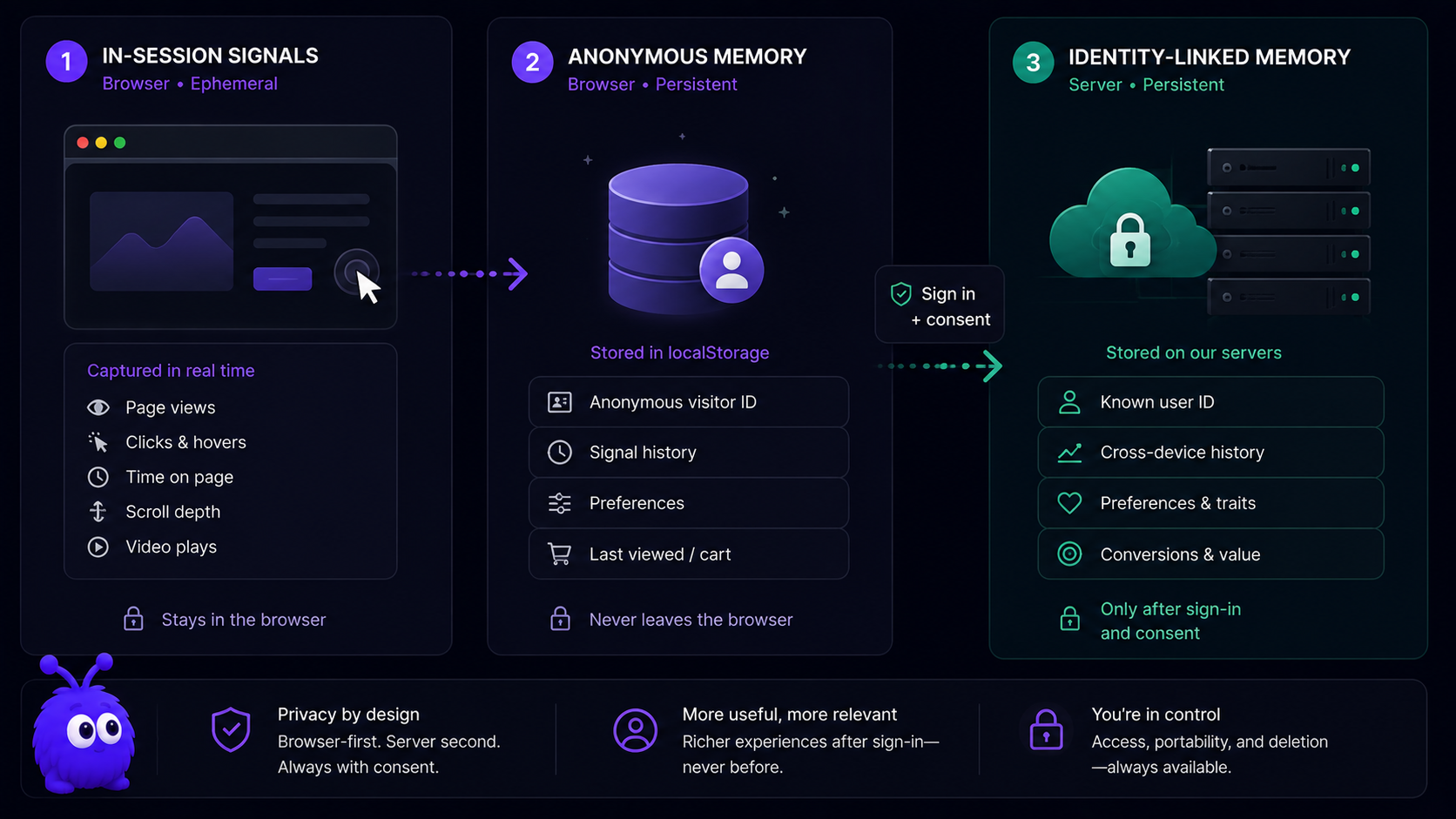
The three-layer privacy architecture
Layer 1: client-side signal processing.
In-session behavior signals (scroll position, dwell time, hover patterns, exit-intent vectors) are computed in the visitor's browser. The signals never leave the browser unless the visitor engages the chat surface, which is a consensual signal that they want to interact.
// Signal accumulation runs entirely client-side
const signals = {
  scrollDepth: window.scrollY / document.body.scrollHeight,
  dwellTime: Date.now - sessionStart,
  hoverElements: trackedHoverState,
  cartItems: getCartFromStorage,
};

// Trigger classifier runs client-side
const shouldFire = classifier.evaluate(signals);

if (shouldFire) {
  // Show intervention - still no server transmission
  surface.show(interventionConfig);

  // Server transmission only if visitor engages
  surface.onEngage( => {
    // Now the visitor has signaled willingness; OK to send to chat backend
    sendToBackend({ signals, message: visitorMessage });
  });
}
The pattern: signals accumulate locally, drive trigger decisions locally, and flow server-side only when the visitor consensually engages.
Layer 2: localStorage memory for anonymous visitors.
Visitor memory stored in the browser's localStorage; keyed by a randomly-generated device ID; not transmitted unless the visitor authenticates.
The classification under GDPR / ePrivacy:
- localStorage data is stored on the visitor's device; the merchant has access only via the visitor's browser running the merchant's JavaScript.
- For functional purposes (remembering throttle state, preferences, dismissal history) most jurisdictions classify this as "functional" or "necessary" cookies / storage, not requiring explicit consent.
- The line is jurisdictional. Strict interpretations of ePrivacy require opt-in for any non-strictly-necessary storage; safe defaults err toward consent.
Layer 3: server-side identity-keyed memory for authenticated visitors.
When the visitor authenticates (logs in, creates an account), the merchant has a lawful basis to associate visitor behavior with their identity (the visitor consented as part of account creation). Server-side memory becomes available.
The visitor's right to deletion (GDPR Article 17, CCPA right to delete) means deletion endpoints must exist. The Yokaify implementation cascades deletion: remove from chat conversation logs, remove from visitor profile, remove from analytics aggregation if individually-identifiable.
Global Privacy Control (GPC)
GPC is a browser-level signal that the visitor wants to opt out of sale and sharing. Sephora and other major retailers were fined in 2024-2025 for not respecting GPC under CCPA enforcement.
const gpcEnabled = navigator.globalPrivacyControl === true ||
                   document.cookie.includes('Sec-GPC=1');

if (gpcEnabled) {
  configureForGPC({
    serverSideMemory: false,
    crossDeviceTracking: false,
    thirdPartyShare: false,
  });
}
The chat surface still works for GPC-enabled visitors (consensual); the surrounding tracking and memory are reduced.
Cookie consent banners and behavioral intervention
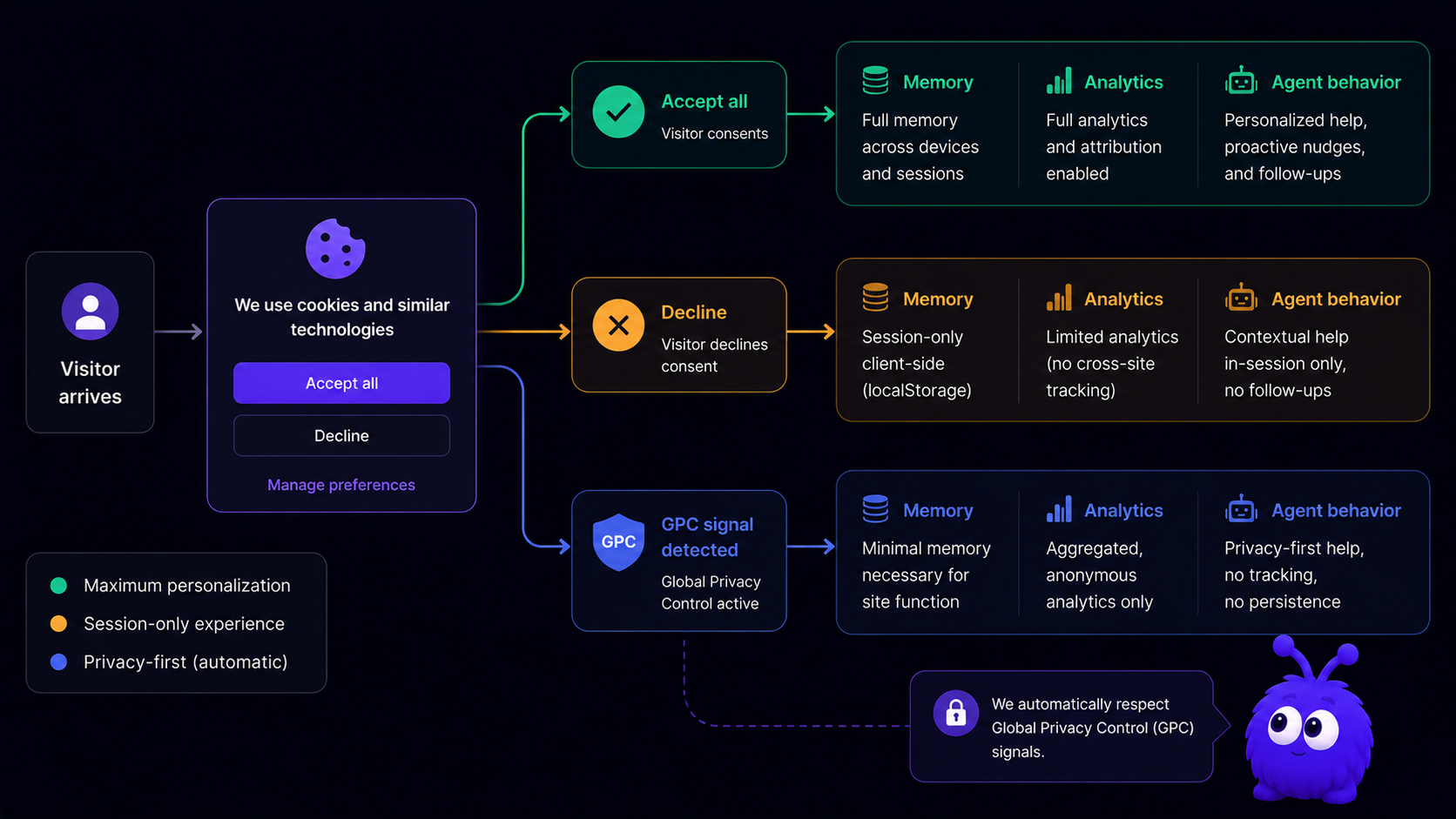
The standard pattern:
- Visitor lands; cookie consent banner displays. 2. Visitor accepts / declines / sets granular preferences. 3. The chat surface respects the visitor's choice.
For visitors who decline:
- Behavior signal accumulation still runs (client-side; not transmitted).
- The chat surface is available; visitor can still engage.
- Visitor memory is session-scoped only (no localStorage persistence).
- No analytics events flow.
- No cross-session memory.
For visitors who accept:
- Full feature set as documented in the consent.
The consent banner should disclose the behavioral intervention specifically; "use of cookies" is too vague for some interpretations. The Yokaify integration with Site Kit (covered in the Site Kit + Yokaify post) inherits Google Consent Mode handling.
Authenticated visitor lifecycle
For authenticated visitors:
Account creation: Consent is obtained as part of the signup flow. The merchant's Terms / Privacy Policy should disclose behavioral intervention.
Active account: Server-side memory accumulates. The visitor's profile includes preferences, throttle state, conversation summaries.
Account deletion / right to be forgotten: Cascading deletion across all systems. Yokaify provides a deletion API endpoint that merchants call when their account-deletion flow runs.
Data export request (GDPR Article 15, CCPA right to know): The visitor's data is exportable. Yokaify's API includes a per-user data-export endpoint that returns the full profile in JSON.
What goes wrong
A few mistakes show up again and again. The most common is sending behavior signals to the server before the visitor has done anything that signals consent, which quietly turns a client-side feature into tracking. Another is treating every piece of localStorage as harmless; strict readings of ePrivacy do not, so storage that is not strictly necessary still needs a clear basis. The third is shipping a privacy notice with no working way to actually delete a visitor's data, which falls apart the moment someone exercises their right to be forgotten - the privacy equivalent of painting a fire exit onto a solid wall. None of these are hard to avoid, but they are easy to overlook when the focus is on conversion.
What this means for buyers
When evaluating a chat tool's privacy posture:
- Ask whether behavior signals are processed client-side or server-side. Server-side requires consent; client-side often does not. 2. Ask how visitor identity is keyed. Anonymous device ID is privacy-friendly; cross-device identity matching without authentication is risky. 3. Ask whether GPC is respected. Tools that ignore GPC are CCPA-violation-prone. 4. Ask for the data deletion endpoint. If there is no path to delete a visitor's data, GDPR right-to-be-forgotten requests cannot be honored. 5. Ask for a sample data-handling agreement. The DPA should reflect the architecture; if the DPA is generic boilerplate, the architecture probably is too.
Privacy is not in tension with intervention quality. The 2026 architecture pattern produces interventions that are nearly as effective as the surveillance-optimised 2018 pattern, with substantially lower legal and brand exposure.
Further reading
- BlogProactive chat compliance 2026The broader compliance framework.
- BlogSession vs visitor memoryThe memory-scope architecture privacy sits inside.
- GlossaryZero-party dataThe privacy-friendly data category.
- GlossaryIntent signalThe signal type that processes locally.
- GuideThe onsite agent playbookWhere privacy fits in the broader category.
Frequently asked questions
Yes. Client-side-only signal processing in-session; localStorage memory anonymous; server-side identity only with auth consent.
Last updated June 10, 2026. Compliance patterns verified against GDPR (Regulation EU 2016/679), ePrivacy Directive (2002/58/EC, current implementation), CCPA / CPRA (California Civil Code §1798.100+), and UK GDPR. Sephora CCPA precedent: 2022 enforcement action and subsequent 2024-2025 GPC-related fines.