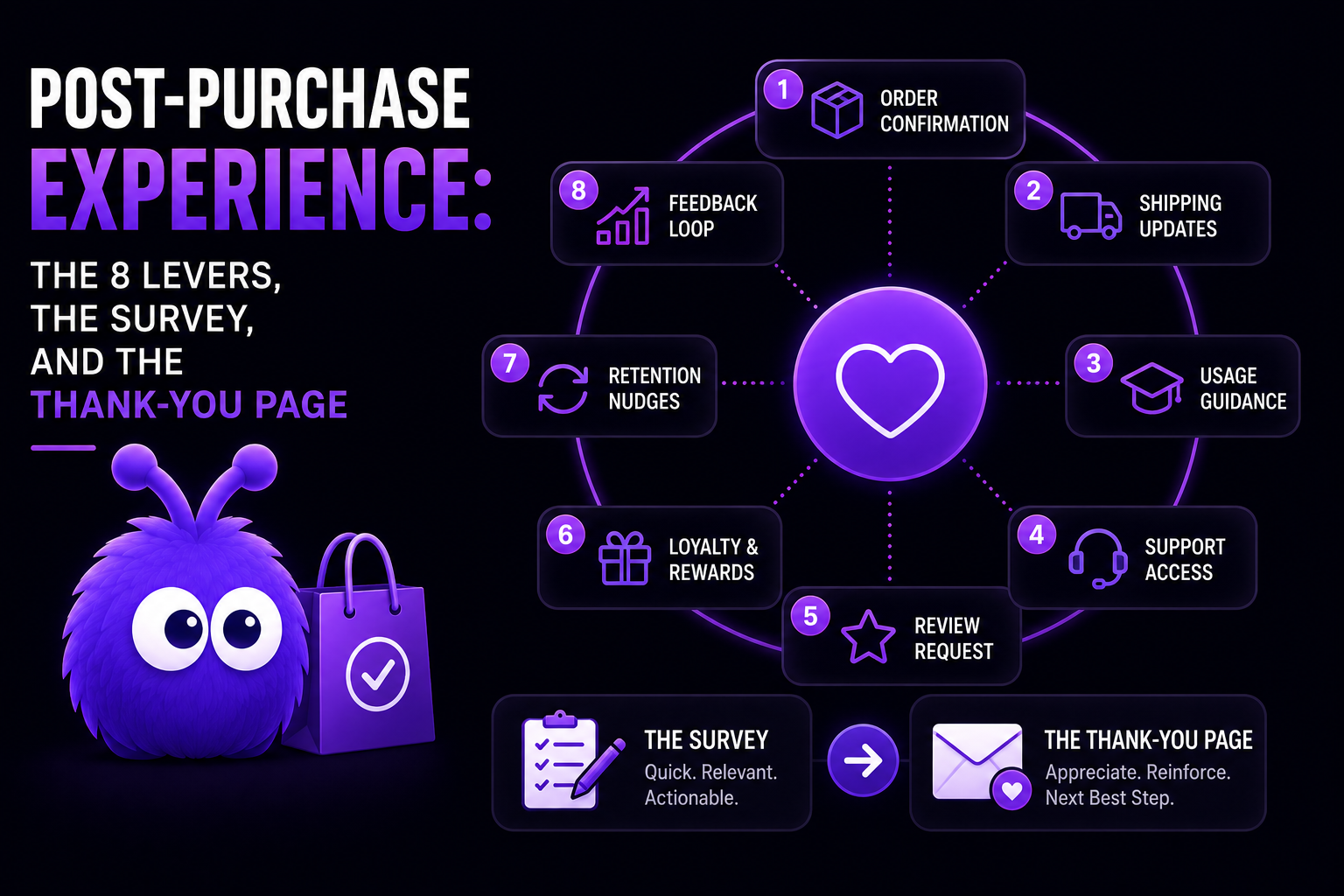
For a DTC brand, the first purchase is the activation moment, and a reorder within 30 days is the sign it stuck. Activation work lifts the first-purchase rate; post-purchase work lifts that 30-day reorder. They sit at opposite ends of the customer journey and call for different tools - and the post-purchase end is the one most stores leave on the table. The thank-you page is prime real estate that the majority of stores use to say "Thanks, your order has been received" and nothing else.
This post covers the eight levers in priority order, the survey questions worth asking, and the WooCommerce-specific implementation of the thank-you page.
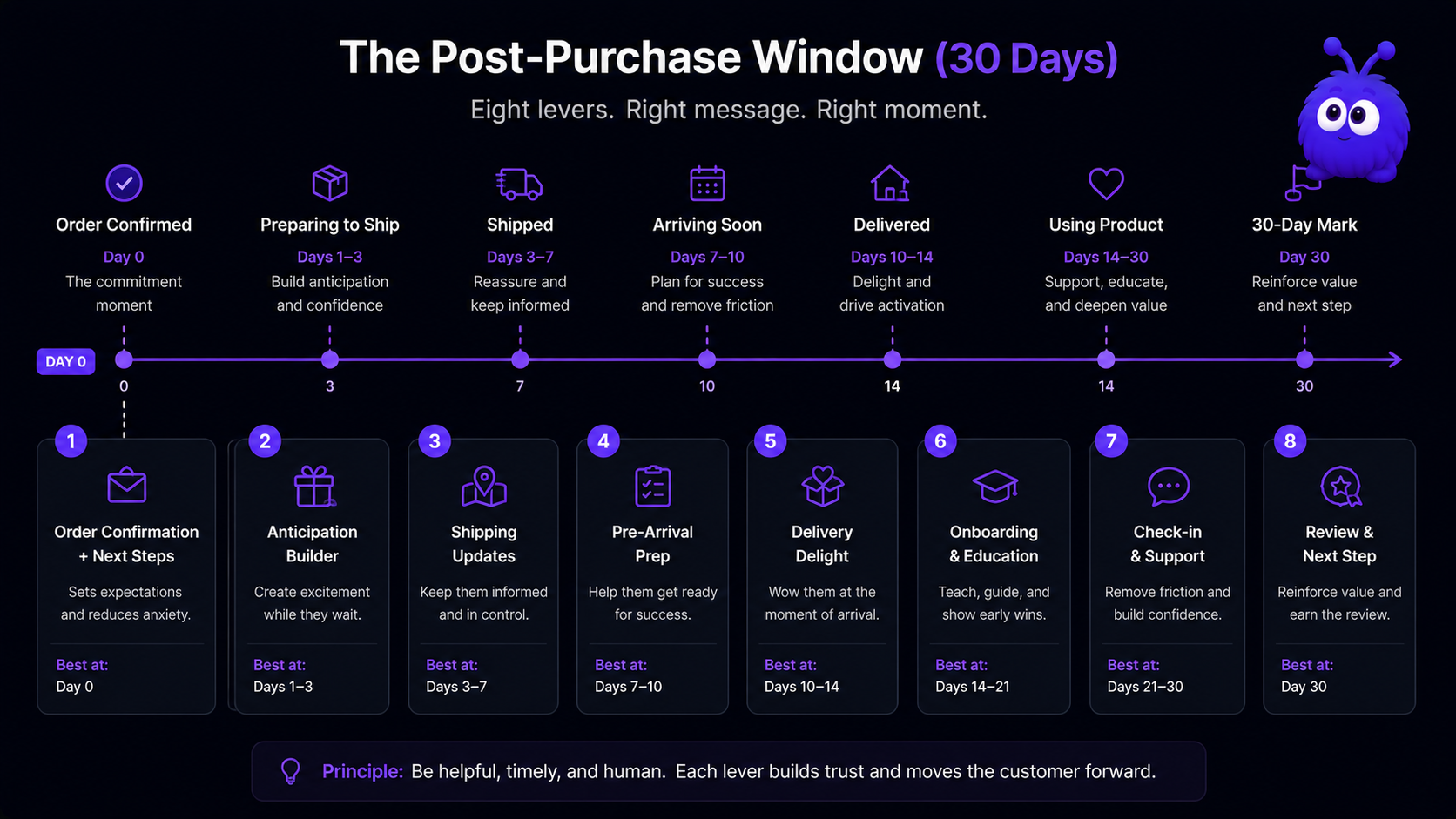
The eight levers in priority order
The order is a function of lift, cost, and dependency. Unboxing (lever 6) is high-impact but needs a higher order value to pay for itself. The referral surface (lever 7) is best added after support and survey patterns are working. Re-engagement after a non-reorder (lever 8) is the last-mile addition once the upstream levers are in place.
Lever 1: Thank-you page copy + survey ask
The first minute after the customer pays is the highest-attention window in the whole relationship. The thank-you page decides whether that attention is captured or wasted. The pattern that works:
- A shipping ETA with an actual date, not "estimated 5-7 business days". Specific dates set expectations the customer can plan against; ranges feel like a shrug.
- An embedded survey, not a link-out. A short survey embedded on the page completes far more often than one that bounces the customer to a separate survey tool.
- A single secondary action, not a dashboard of options. One obvious next step - take the survey, refer a friend - beats five competing ones.
Lever 2: Shipping ETA accuracy
The ETA on the thank-you page sets the expectation; the actual arrival tests whether the brand keeps its word. The mechanism is trust accumulation - a customer who saw one accurate delivery cycle commits to the second purchase faster. Integrate real carrier tracking (ShipStation, Shippo, EasyPost all expose it), pad the window slightly so you under-promise and over-deliver, and get ahead of any slip with a proactive notification. A silent slip is the trust-killer.
Lever 3: First-touch support availability
The customer's first support interaction in the first couple of weeks is weighted heavily in retention. A problem resolved quickly can leave a customer more loyal than one who never had a problem at all; the same problem left to fester becomes a churn driver. The implementation is any channel that hits a fast first response on critical post-purchase issues - in-session intervention, chat with human handover, or prioritised email triage. The channel matters less than the response time.
Lever 4: Second-purchase incentive
What works: a small discount on a curated category ("10% off your next [related-category] purchase", not "10% off everything"), a free-shipping pass for the next month, or a free sample with the second order. What does not: a generic "20% off your next order" with no context, which becomes wallpaper, and aggressive discount stacking, which just trains people to wait for the next sale. The offer has to feel earned by the first purchase, not transactional.
Lever 5: Cross-sell timing
Cross-sell on the thank-you page rarely lands - the customer just made a decision, and a pitch at that moment reads as an upsell. Cross-sell a week or two after arrival, once they have used the product, reads as complementary discovery instead. That post-arrival window is where "what else goes with this" thinking actually happens.
Lever 6: Unboxing experience
Worth it above a certain order value; below it the math rarely works. Nicer packaging, thoughtful inserts, and the small touches that signal quality lift reorder, but once you net out the cost of the packaging against the reorder lift, low-AOV stores can spend more than the order's margin. Stores in that band should put their effort into the cheaper levers.
Lever 7: Referral surface
The right time to ask is a week or two after arrival, not on the thank-you page. A thank-you-page ask lands on someone who has not used the product, so their endorsement is committal but shallow, and the referral converts worse. A post-arrival ask - ideally tied to a "how's it going?" check-in - lands on someone with a real opinion, and converts meaningfully better. A simple email referencing the actual product ("hope you're loving the [product] - here's a link if a friend would too") is enough.
Lever 8: Re-engagement after non-reorder
For customers who did not reorder by day 30, a re-engagement nudge a few weeks later recovers a small but real cohort: a "we miss you" email with a genuinely curated pick, a modest re-engagement offer framed as a thank-you, and a short "why didn't you come back?" survey that feeds product and marketing. Smaller than the upstream levers, but meaningful at scale.
The post-purchase survey: which questions actually drive decisions
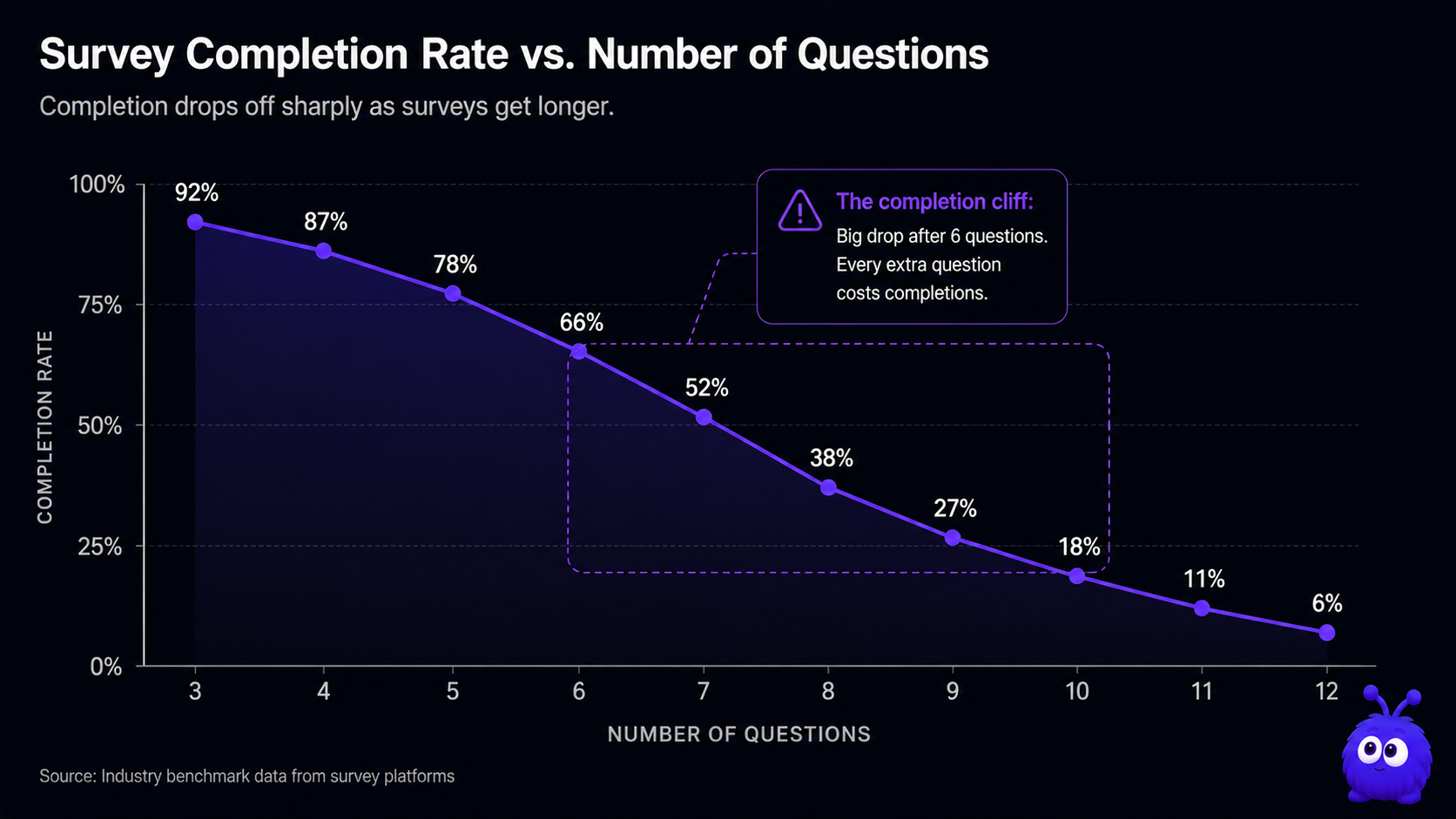
A post-purchase survey is about the best research moment you get in ecommerce - the traffic is warm, the respondent just bought something, and they have a specific order fresh in mind. Most stores waste it, either skipping the survey or padding it until nobody finishes. The discipline is simple: keep it to about five questions, and keep only the ones that drive a real decision.
The question types worth asking:
- How did you find us. Multiple choice with predefined channels. Feeds channel-spend decisions, high completion, low noise.
- What almost stopped you from completing this purchase. The respondent is a converter, so their answer is a lower bound on what stops a non-converter. Multiple choice plus an "other" field. The most actionable question for funnel work.
- An NPS-style score. "How likely are you to recommend us, 0-10?" A comparable cross-store benchmark that surfaces your promoter/detractor split. Include it; don't let it be the whole survey.
- A category-specific question. Apparel: did the size match expectation? Electronics: setup ease. Food: taste and freshness. Furniture: assembly. This is often the highest-leverage question, and the one generic surveys miss.
- One open-ended. "Anything else you'd like us to know?" Lower completion, irreplaceable signal - people raise things you didn't think to ask. Keep it to one, and put it last.
Wording matters more than it looks: a scale ("how likely are you to recommend us?") draws more responses than a yes/no, and a negative framing ("what almost stopped you?") surfaces actionable issues where a positive one ("why did you choose us?") just collects generic praise.
Placement follows the question type. Funnel questions belong on the thank-you page, where completion is highest. Product-experience questions belong in the delivery email, after the customer has actually used the thing. Retention-intent questions belong about a week after delivery. And survey data without an action loop is just noise - review the "what almost stopped you" answers weekly with a specific fix in mind (ship a shipping-threshold nudge if cost is the top answer; rewrite the return policy if that's what keeps coming up).
Implementing the thank-you page on WooCommerce
WooCommerce gives you the thank-you page (the order-received endpoint at /checkout/order-received/{order_id}) as the surface for lever 1. There are three ways to customise it.
Pattern 1 - the woocommerce_thankyou hook (most flexible; fires inside the template with the order ID):
add_action('woocommerce_thankyou', function ($order_id) {
  if (!$order_id) return;
  $order = wc_get_order($order_id);
  if (!$order) return;
  echo '<div class="post-purchase-upsell">';
  echo '<h2>Recommended for you</h2>';
  echo render_recommendations_for_order($order);
  echo '</div>';
}, 10);
Priority controls position: priority 5 renders near the header (good for a thank-you message), priority 10 mid-page (good for an upsell), priority 15-20 near the footer (good for a survey or referral prompt).
Pattern 2 - woocommerce_order_details_after_order_table hands you the order object directly and renders just below the order summary. It's the right hook for per-product context like care instructions or warranty info.
Pattern 3 - a template override (your-theme/woocommerce/checkout/thankyou.php) for full restructuring. It gives total control at the cost of maintaining compatibility with WooCommerce template updates - so reserve it for significantly redesigned pages, and preserve the do_action('woocommerce_thankyou', ...) call so other integrations keep working.
Caching is rarely an issue here: the thank-you URL contains the order ID and a unique key, and most caching plugins exclude /checkout/order-received/* by default (WP Rocket does automatically; W3 Total Cache and LiteSpeed may need the path added). Verify it after install, though - a cached thank-you page that serves one customer's order details to another is a privacy incident, not just a bug.
One more thing not to break: the thank-you page is where most post-purchase analytics fire (GA4 purchase events, Meta Pixel, Klaviyo's Placed Order). If you customise heavily, make sure those hooks still run.
| Customisation | Hook + priority | Effect | When to ship |
|---|---|---|---|
| Order tracking link | woocommerce_thankyou priority 7 | Fewer support tickets | Stores with 3+ days shipping |
| Post-purchase upsell | woocommerce_thankyou priority 10 | Lifts reorder rate | Stores with complementary products |
| Care instructions | woocommerce_order_details_after_order_table | Reduces returns | Apparel, electronics, beauty |
| Post-purchase survey | woocommerce_thankyou priority 15 | High completion on warm traffic | Stores measuring CSAT |
| Referral / share prompt | woocommerce_thankyou priority 20 | Adds referral conversion | Stores with referral programs |
How Yokaify handles the post-purchase moment
Yokaify fires a post-purchase intervention on order completion: the mascot shifts to a celebration state, a brand-voice thank-you renders, and an optional short survey and referral or next-purchase nudge follow for stores that have configured them. On WooCommerce it hooks into woocommerce_thankyou automatically, so merchants don't write template code; the survey tooling can drop inline form code into the same hook.
The point is that it uses the moment to be useful - confirm the order, set the delivery expectation, ask one good question - rather than to high-five the customer and vanish. Nobody has ever felt more loyal because a thank-you page threw confetti at them.
Further reading
- GlossaryLifetime valueHow reorder-30 compounds into CLV.
- GlossaryZero-party dataThe data category surveys produce.
- GuideThe CRO reference for 2026Where post-purchase sits in the broader CRO playbook.
- GuideWooCommerce chatbot 2026 buying guideWhere thank-you customisation fits the stack.
- BlogCart abandonment psychology 2026The "what almost stopped you" cohort context.
Frequently asked questions
Everything between order confirmation and the second purchase or churn - a roughly two-to-four week window for DTC, and the highest-attention stretch of the relationship.
Last updated June 10, 2026.