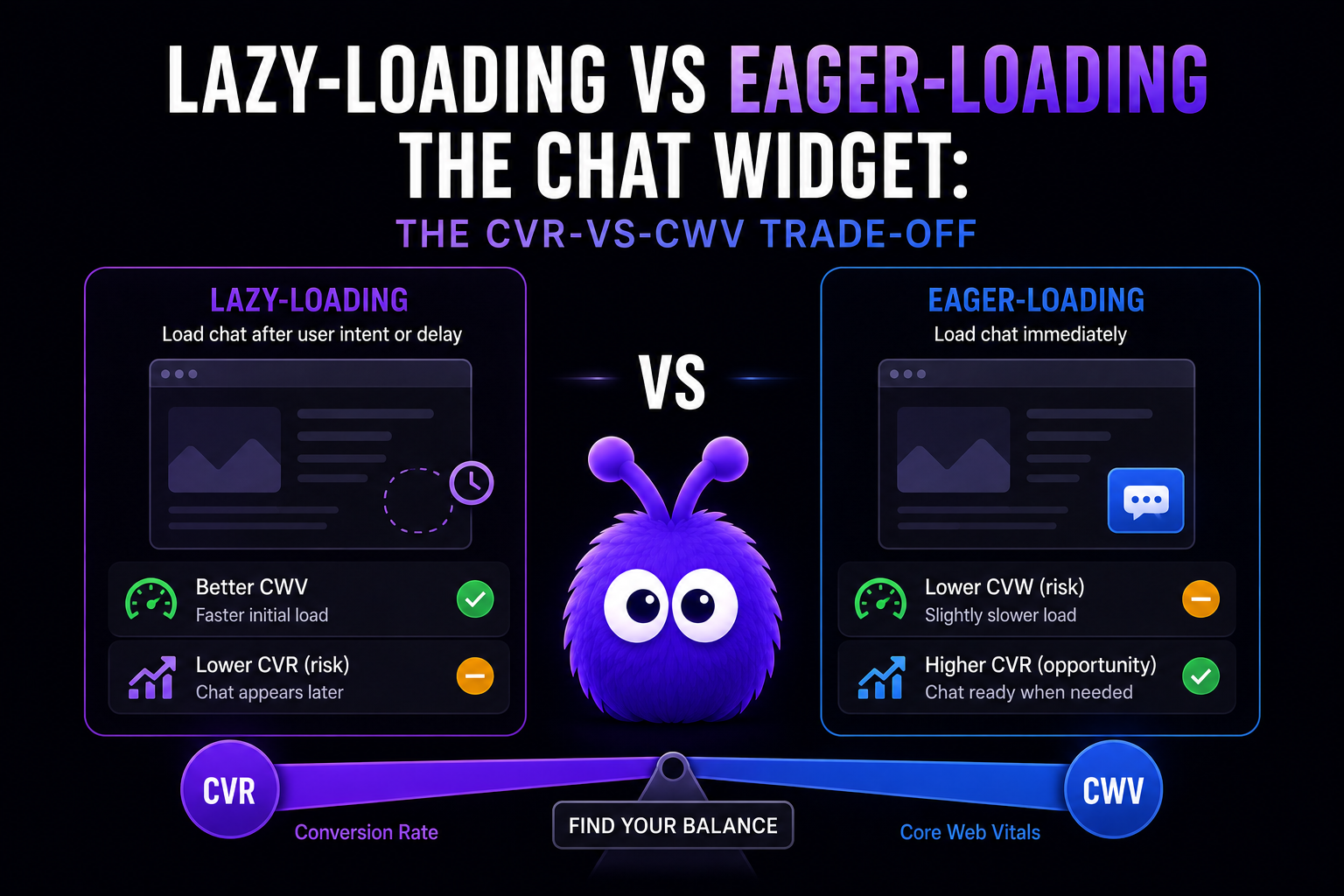
Lazy versus eager comes up constantly when people set up a chat widget. An eager-loaded widget is ready the instant the page loads; a lazy-loaded one waits a moment so it does not slow down everything else. A couple of years ago the common advice was to load eagerly and chase engagement. The better answer now is to load lazily, because it protects your Core Web Vitals and engagement comes out about the same either way.
Here is what the trade-off actually is, what eager-loading costs you, and how to set things up so visitors who want to chat still can.
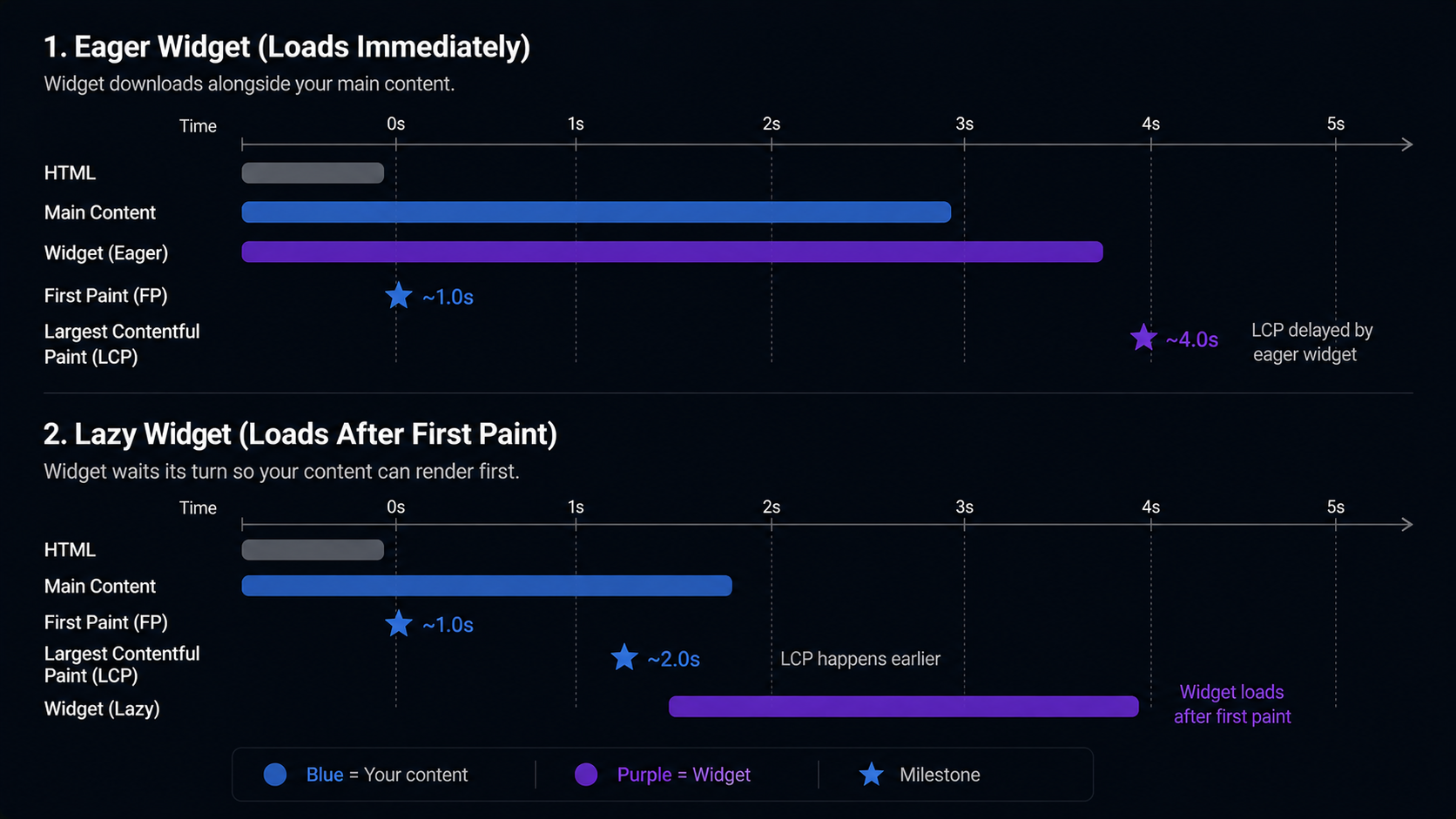
The two approaches in production
| Approach | Loading time | Bundle in initial HTML | Largest-paint impact |
|---|---|---|---|
| Eager-load (synchronous) | During page parse | Yes (or via head script) | Regresses LCP |
| Eager-load (async) | During page parse, downloads in parallel | Yes (async script) | Regresses LCP (less) |
| Lazy-load (no delay) | Immediately after DOMContentLoaded | No | Negligible |
| Lazy-load (short delay) | A beat after first paint | No | None |
| Lazy-load (long delay) | Several seconds after first paint | No | None, but late for CTA clicks |
The shape of the trade-off: the eager approaches all regress your largest paint to some degree; the lazy approaches differ only on perceived availability. A no-delay or very short lazy load can feel slightly jarring because the bubble pops in while the page is still settling; a very long delay leaves visitors who go looking for chat wondering where it went, like a shop assistant who picked the worst possible moment to nip out for tea. A short delay - long enough that the page has settled, short enough that nobody notices the wait - is the sweet spot.
Why engagement does not really differ
The intuition behind eager-loading is that visitors who land intending to chat will see the bubble fast and click it. In practice that intuition does not hold up, for three reasons:
Most visitors don't intend to chat on landing. They browse, read, scroll. By the time they are ready to chat - typically some seconds in - a lazy-loaded bubble has been sitting there waiting the whole time. Engagement happens in the late phase, not the first second.
Visitors who do intend to chat scroll and look. They scan for the bubble; they do not expect it instantly. A short delay falls comfortably inside the natural "I'm orienting on this page" window.
Behavior-triggered chat handles real intent anyway. Yokaify surfaces interventions based on signals like cart-stage hesitation or pricing-page dwell, and those fire on their own schedule regardless of when the bubble's script loaded. The clickable bubble is a fallback, not the main event.
The combined effect: the chat surface's availability is measured in seconds of browsing, not milliseconds of load time. The difference between an instant bubble and one that appears a beat later sits below the perception threshold for engagement.
Why eager-loading regresses your largest paint
The mechanic is resource competition. The chat widget's bundle competes with the page's critical resources during the page-parse window:
Bandwidth competition. On a mid-tier mobile connection, every kilobyte of widget bundle is bandwidth your largest-paint resource could have used. A heavy, eagerly-loaded messenger can pull a meaningful slice of it.
Main-thread blocking. JavaScript parsing and execution blocks the main thread. While the browser is busy parsing the widget, it cannot lay out and render the largest-paint element.
Connection competition. HTTP/2 and HTTP/3 multiplex requests, but prioritisation still matters. An eager widget script competes for connection priority against the image and CSS that make up your largest paint.
The net effect is that eager-loaded widgets push the largest paint back. A lazy load after first paint sidesteps all three, because by then the critical resources have already had the runway to themselves.
Why this matters more after March 2026
Until recently, a widget that hurt one page's largest paint hurt only that page's ranking. The March 2026 core update changed that: Google shifted Core Web Vitals from a per-URL signal toward a site-wide one, aggregating field data across a domain's high-traffic pages into a grade that applies to the whole site (Google Search Central, March 2026 core update). Independent tracking through April 2026 reported broad ranking volatility, with a large share of sites seeing measurable movement.
The practical consequence: a heavy third-party script that loads everywhere - chat widget, ad pixel, cookie banner - is now a domain-level decision, not a per-page one. The CWV thresholds themselves did not change:
| Metric | Good | Needs improvement | Poor |
|---|---|---|---|
| LCP | Under 2.5 s | 2.5 - 4.0 s | Over 4.0 s |
| INP | Under 200 ms | 200 - 500 ms | Over 500 ms |
| CLS | Under 0.1 | 0.1 - 0.25 | Over 0.25 |
What changed is that you can no longer optimise your top pages and let the long tail rot - a few slow pages now set the tone for the domain. A chat widget that loads eagerly on every page is exactly the kind of shared cost that shows up site-wide. Which is a long way of saying: this is one more reason to lazy-load.
How to keep chat available where it matters
Lazy-loading by default does not mean making high-intent visitors hunt for chat. The pattern is a conservative default plus a per-page opt-in.
The standard install lazy-loads after first paint:
<script async src="https://cdn.yokaify.com/widget.js" data-site-key="YOUR_SITE_KEY"></script>
For pages where chat is the conversion path - sales pages, demo requests, the contact route, pricing comparisons - load the widget immediately after paint instead of waiting, or trigger the load when the visitor clicks a "Chat with our team" button so it is ready the instant they ask. The largest-paint cost on a single high-intent page is negligible, and those visitors came to talk anyway.
For every other page, the short default delay holds. The point is to make the choice deliberately, page by page, rather than shipping one strategy everywhere and hoping.
What this means for buyers
Three things to check when you evaluate a chat tool in 2026:
- Inspect the default loading strategy. A vendor that still defaults to eager-loading is shipping the 2023 default; the 2026 default is lazy.
- Test the largest-paint regression yourself. Run Lighthouse before and after install. If the widget meaningfully drags your largest paint, it is now dragging your whole domain with it.
- Demand a per-page configuration option. A vendor with no way to vary the load strategy forces every page into the same compromise. The right answer is a conservative default plus an opt-in for the pages that earn it.
The shorthand: lazy-load by default, go eager only where the page justifies it, and never trade Core Web Vitals for engagement you were not going to lose anyway.
Further reading
Frequently asked questions
Eager runs during page parse; lazy defers until after first paint. Eager is available fastest; lazy protects your largest paint.
Last updated June 10, 2026.