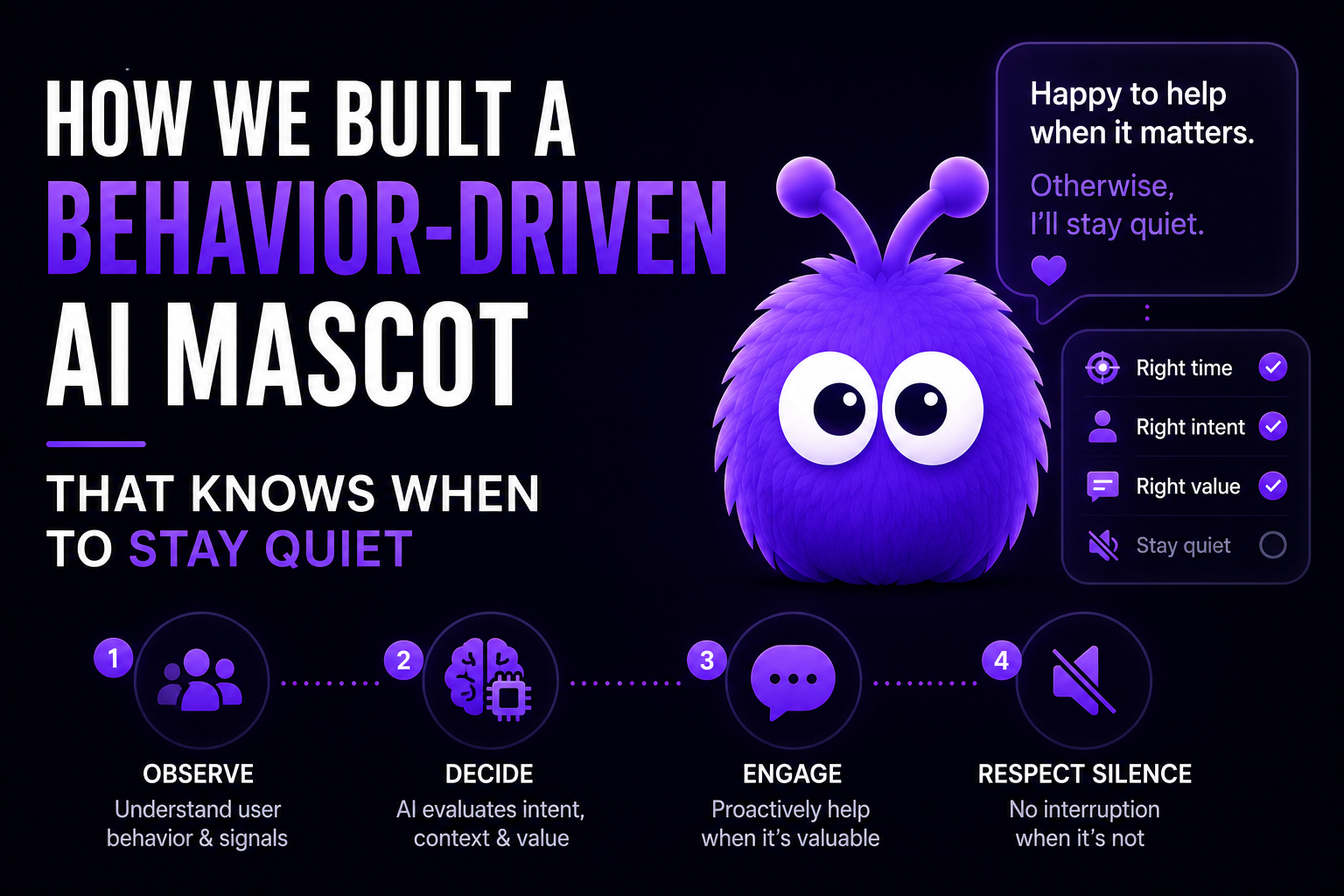
Most website widgets are built to interrupt. They fire on a timer, throw a coupon at you, and call it engagement. We wanted the opposite: a character that behaves like the best salesperson on a quiet shop floor — present, attentive, and almost invisible until the exact second you glance up looking for help. That single design goal shaped every decision that followed, and it is the reason the hardest problems we solved had almost nothing to do with making the mascot cute.
This is the story of how the Yokaify mascot came together: what we obsessed over, what we threw away, and why "knowing when to stay quiet" became the whole product.
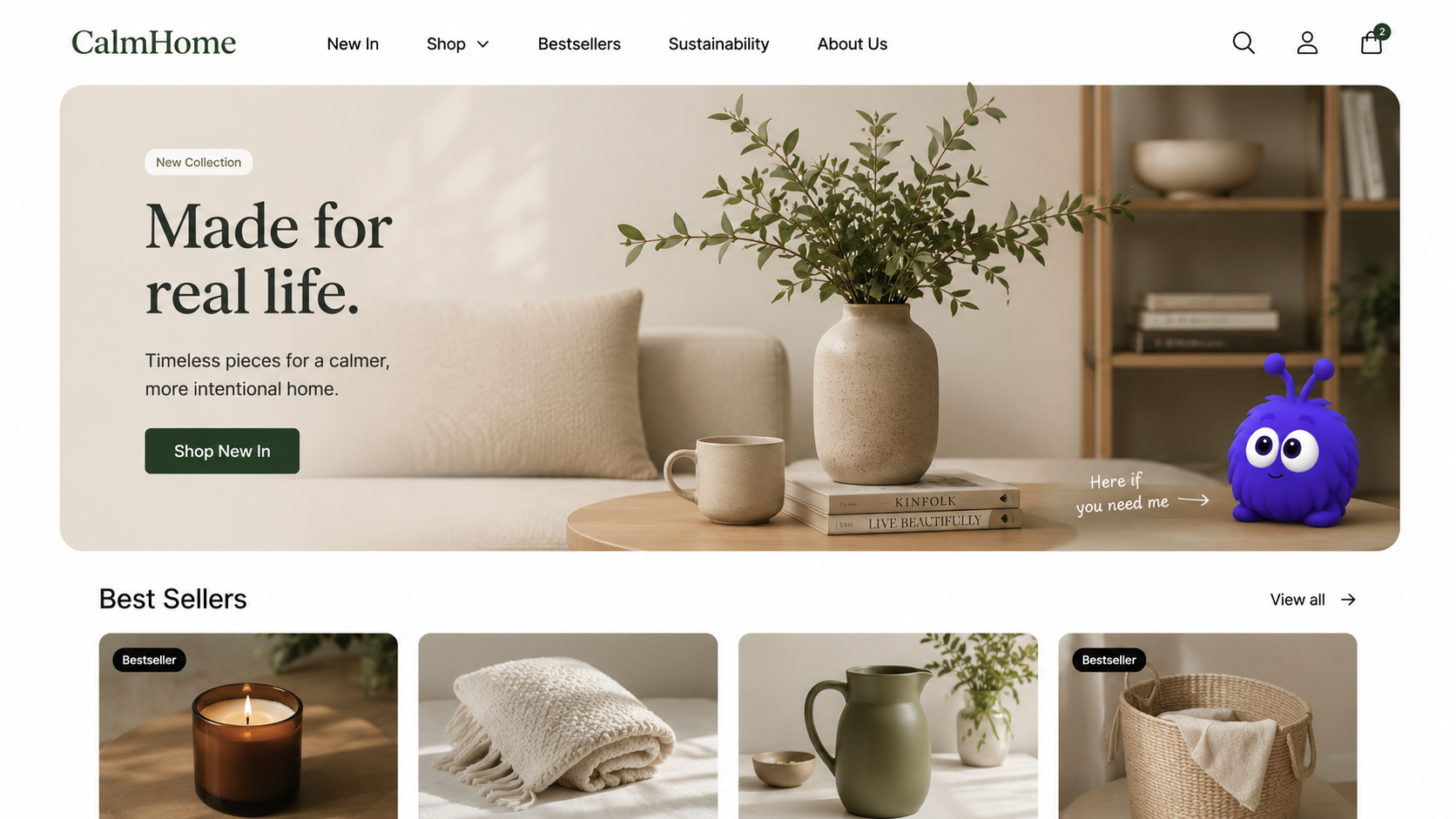
What makes a mascot feel alive instead of annoying?
The difference between a character that feels alive and one that feels like spam comes down to a sense of social timing. A real person helping you in a store reads a hundred tiny cues — whether you are scanning or searching, lingering or leaving, confident or lost — and they calibrate when to step forward and when to give you room. Get that calibration wrong in either direction and the magic collapses: too eager and it is a pushy clerk, too passive and it is wallpaper.
We spent most of our effort teaching the mascot the equivalent of that instinct. Not a script, not a countdown, but a feel for the shape of a visit. The character has what we think of internally as a sense of presence: it is aware of the room, it understands the emotional texture of a session, and it treats every decision to appear as a decision it has to earn. When it does step in, the goal is for the moment to feel less like a notification and more like someone who happened to be nearby noticing you needed something.
That instinct is the part we are proudest of, and it is the part you will never see in a settings panel. It just feels right, which is exactly how it is supposed to feel.
The hardest problem was timing, not animation
Animation is a solved craft. Beautiful character motion is hard work, but it is known work — there are decades of principles to draw on, and the tools are mature. We could make the mascot blink, breathe, tilt its head, and react with personality fairly early on. None of that was the real challenge.
The real challenge was orchestration: deciding, continuously, what the character should be doing right now given everything happening on the page. A mascot that animates beautifully but reacts to the wrong moment is worse than no mascot at all, because now your bad timing is also charming, which makes it memorable for the wrong reasons. We needed the choreography — the layer that turns a visitor's behavior into the character's behavior — to be effectively flawless, because that is the layer a human actually experiences.
We rebuilt that orchestration more times than I would like to admit. Each version got quieter. The earliest one was, frankly, a try-hard — it wanted to help with everything, the way an over-caffeinated intern wants to help with everything. The version that finally worked was the one that learned to do less, more precisely.
Designing a sense of restraint
Restraint is a strange thing to engineer because success looks like absence. When the mascot is working perfectly, nothing happens — it watches a confident shopper sail through checkout and never says a word, and that silence is a feature we fought hard for.
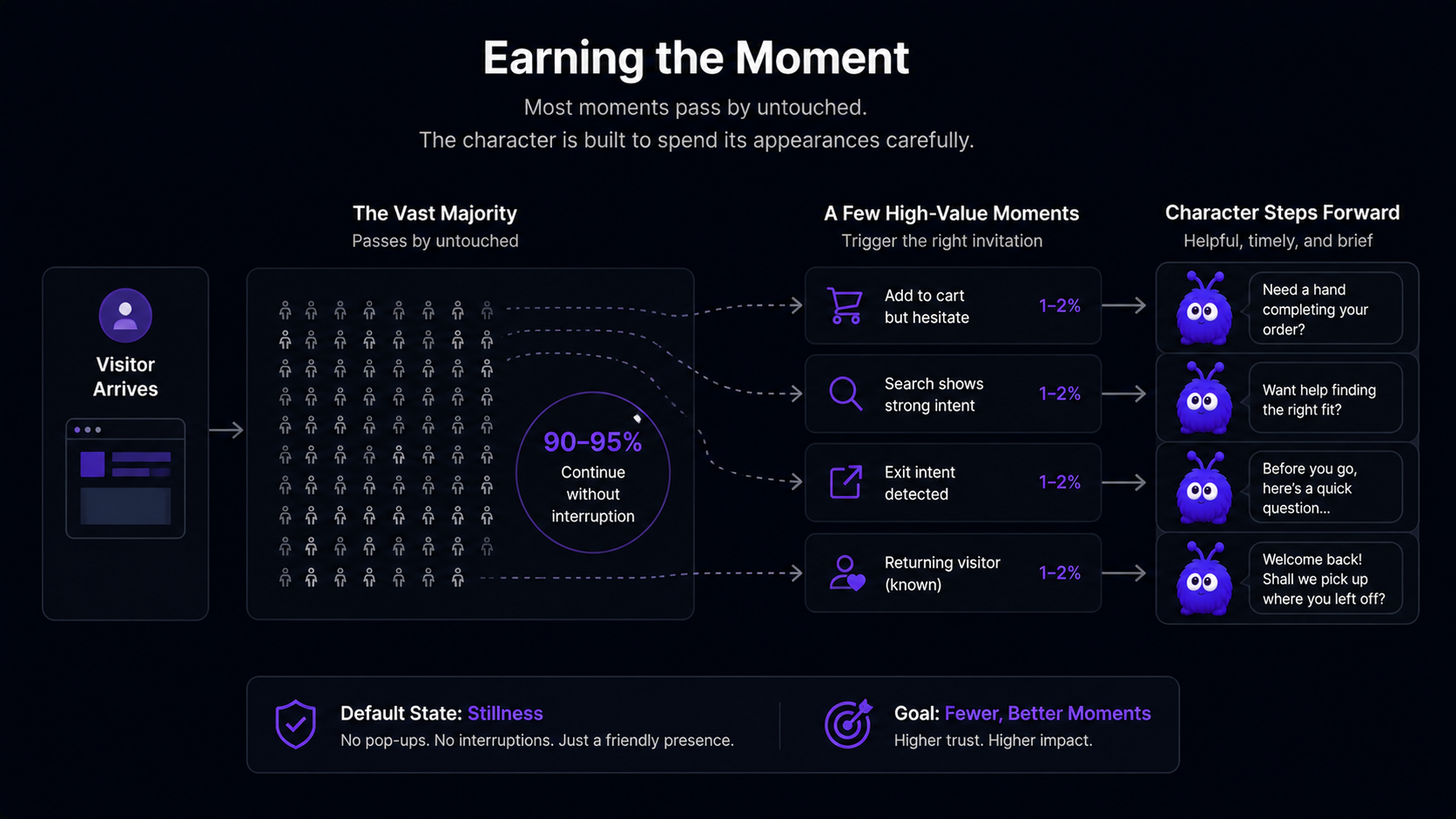
The principle we kept coming back to: every appearance spends a little of the visitor's goodwill, so it had better buy something back. If the character cannot make the moment genuinely more useful, the correct move is to stay still. We tuned the whole experience around that trade, and it is why the mascot will happily sit out an entire visit if that visit does not need it. A widget that always talks is easy to build. A character that knows when not to is the entire point.
Giving the character a feel for the moment
A mascot that reacts to the present moment but forgets it a second later feels twitchy and shallow. So we gave the character a sense of continuity — a feel for where this visit has been, not just where it is right now. It understands the arc of a session the way you remember the arc of a conversation: what was tried, what stalled, what the person seemed to be reaching for. That continuity is what lets a single, well-placed line land as thoughtful rather than random.
We deliberately keep how that works out of public view, and out of the product surface, because the experience is the promise — not the plumbing. What matters to a visitor is that the character feels like it has been paying attention the whole time. What matters to a store owner is that this attentiveness shows up as help at the right moment instead of noise at the wrong one.
Why we obsess over the feeling of instant
There is a threshold of responsiveness below which an interface stops feeling like software and starts feeling like a presence. Above it, even a gorgeous animation feels like a thing reacting to you. Below it, the character feels like it is simply there with you. We treat that perceived instantness as non-negotiable, because the entire illusion of a living character depends on it. A mascot that hesitates is a mascot you stop believing in.
So a huge amount of unglamorous work went into making the character feel weightless on the page — quick to wake, quick to respond, and careful never to get in the way of the page itself loading and behaving normally. The fanciest behavior in the world is worthless if the visitor feels the site get heavier the moment the mascot shows up. Our standing rule is that the page comes first, always; the character is a guest on it.
| Dimension | The interrupting widget | The behavior-driven mascot |
|---|---|---|
| Default behavior | Talks on a timer | Stays quiet by default |
| What triggers it | A fixed delay or a page load | A read of the actual moment |
| Goal of an appearance | Maximize impressions | Earn a single useful moment |
| How success looks | More pop-ups shown | Fewer, better-timed appearances |
| Effect on trust | Erodes it over time | Builds it when done with restraint |
Where we are taking it next
The character will keep getting better at the thing it already does: reading the moment and choosing well. We are pushing toward a mascot that feels even more naturally conversational, even more tuned to the specific texture of each store, and even more disciplined about staying out of the way. We will share how that lands as real results come in — and when we do, it will be measured, dated, and honest, the same standard we hold every claim on this site to.
If you want the wider picture of where a character like this fits in the modern conversion stack, start with our guide to the onsite conversion agent, and the deep dive on using Rive for ecommerce animation. If you are weighing the character itself, the honest breakdown in animated character vs static avatar is the place to go — and if you are worried about the ethics of any of this, we wrote when an AI mascot becomes manipulative precisely because we worry about it too.
Frequently asked questions
An animated onsite character that decides when to appear based on the shape of a real visit rather than a fixed timer or a page load. Its defining trait is restraint: it stays quiet unless stepping in would genuinely help.
Further reading
- GuideThe onsite conversion agent guideWhere a behavior-driven character fits in the modern conversion stack.
- GuideRive animation for ecommerceThe craft of bringing a character to life on a storefront.
- BlogAnimated character vs static avatarThe honest case for and against an animated mascot.
- BlogWhen an AI mascot becomes manipulativeThe ethical line we designed the character to stay behind.
- ToolNext.js Rive wrapper generatorThe boilerplate for mounting a character cleanly in Next.js.
- vs.Next.js vs Remix for ecommerceThe framework decision underneath a storefront build.
Last updated June 10, 2026.