Tidio is one of the most popular live-chat platforms around. It holds 4.7/5 on G2 across more than 1,600 reviews, has a mature Shopify integration, and ships a solid AI chatbot called Lyro for automated Q&A. If you want reactive chat done well, it is a safe pick.
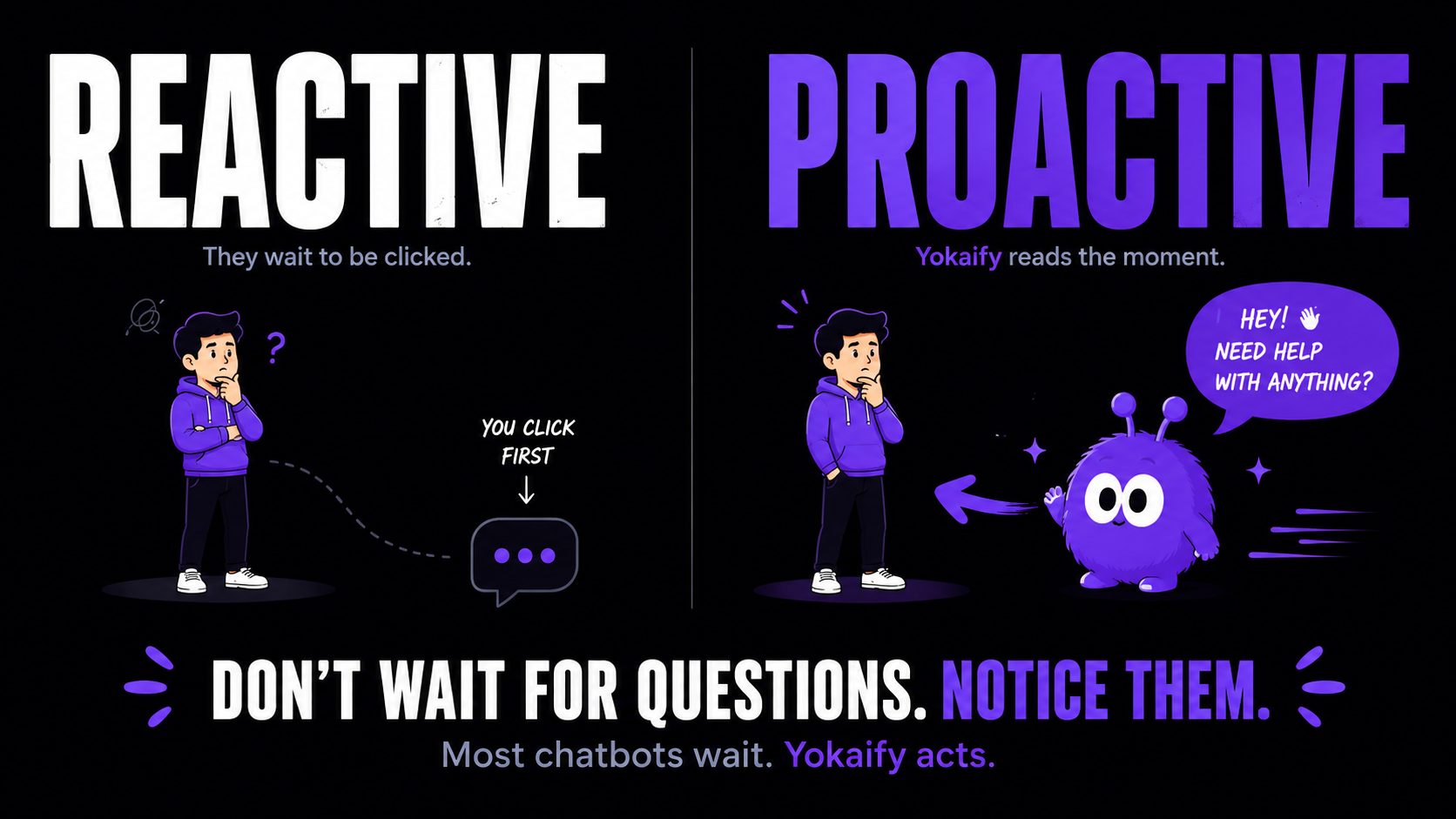
Yokaify is a different kind of tool. It is an Onsite Conversion Agent: a friendly mascot that watches how visitors move through your store and offers help on its own, at the moment it is most likely to matter. People shopping for "chat tools" in 2026 often end up comparing these two without realizing they solve different problems.
So this is a straight, two-sided comparison. Both tools are genuinely good at what they do. The right choice comes down to which visitors you are trying to reach.
Feature comparison
| Feature | Yokaify | Tidio |
|---|---|---|
| Primary surface | Proactive behavior-driven intervention | Reactive live chat + chatbot |
| Direction of initiation | Agent initiates on behavior signal | Visitor initiates on click (or rule-based trigger) |
| Visitor reach (% of total traffic) | 85-95% | 4-11% (click cohort) |
| Behavior-driven multi-signal triggers | Yes | No |
| Rule-based triggers (time, URL, country) | Supported but secondary | Yes |
| Brand-matched mascot / character surface | Yes | No |
| Generic chat-bubble icon | Secondary (available) | Primary |
| Continuous holdout measurement | Yes | No |
| RAG grounding over merchant content | Yes | Lyro knowledge base (reactive only) |
| AI chatbot for Q&A | Yes | Lyro AI |
| Live human-agent handoff | Webhook-based | Built-in inbox |
| Shopify integration | Yes | Yes |
| WooCommerce integration | Yes | Yes |
| Multi-channel (email, Messenger, Instagram) | No | Yes |
| Visitor list / CRM features | Basic lead capture | Full visitor list + CRM |
| Canned responses / saved replies | No | Yes |
| Departments / routing | No | Yes |
| Cart-stage intervention | Yes | Via automation rule |
| Return-visit re-engagement | Yes | Partial |
| Banner-blindness resistance | Yes | No |
| Free tier | Limited | Yes (basic) |
| Suitable as primary conversion surface | Yes | No |
| Suitable as primary support surface | No | Yes |
Pricing and feature data last verified:
Ratings comparison
Ratings last verified:
Tidio's review volume reflects a mature product with years of market presence. Yokaify's review count is early-stage. The scores are similar; the category positioning is not.
When Yokaify wins
When Yokaify wins
- Stores optimizing for visitors who never click chat icons (85-95% of traffic)
- Cart-stage and checkout-stage friction recovery via behavior signals
- Brands wanting a mascot-driven surface that defeats banner blindness
- Operators who need holdout-based causal-lift measurement
- Merchants wanting RAG-grounded responses from their own site content by default
- Teams that want proactive intervention as the primary surface, not an add-on
When Tidio wins
- Support-heavy stores needing a full inbox with departments and routing
- Multi-channel businesses (email, Messenger, Instagram DMs from one inbox)
- Teams that need live human-agent handoff with built-in operator UI
- Stores wanting a proven Shopify app with thousands of reviews
- Businesses that need CRM-style visitor tracking and lead scoring
- Budget-constrained teams that want a generous free tier for basic chat
Where Tidio is the better choice
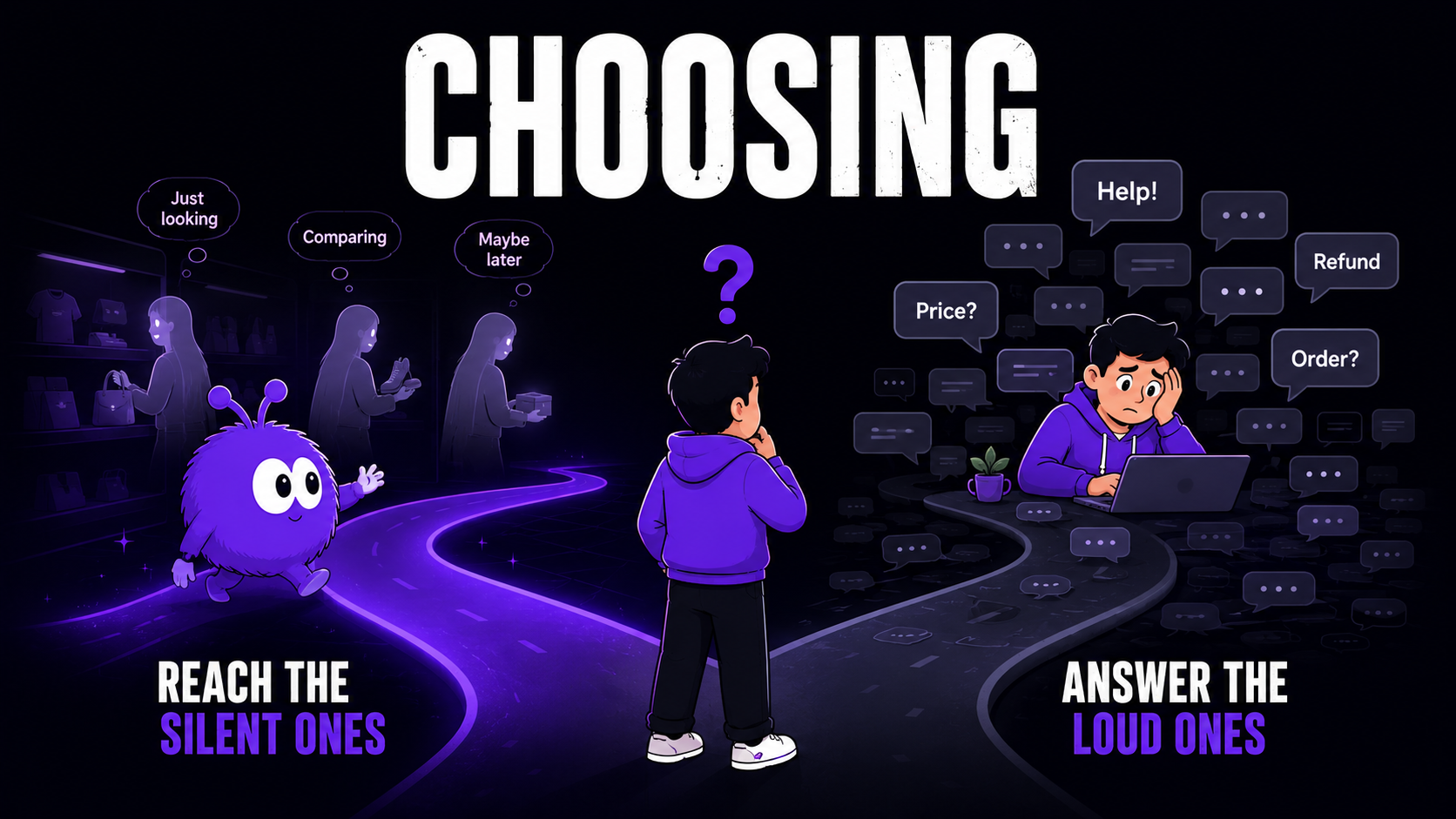
Tidio wins when a visitor has a question and wants to ask it. Everything is built around that moment: inbox management, routing, canned responses, multi-channel unification, and live-agent handoff. If your main problem is "people message us and we need to answer quickly across channels," Tidio is a mature, well-reviewed answer.
It also wins on breadth. One inbox pulls in email, Messenger, and Instagram, so a support team works from a single place. Yokaify stays narrow by design. It focuses on the on-site conversion moment and does not try to be a full communications platform.
Where Yokaify is the better choice
Yokaify wins when the visitor has no question, or does not yet know they have one. It is built for the 85-95% of traffic that never clicks a chat icon but would still convert if the right nudge showed up at the right time.
Here is what gives it the edge with that group:
Behavior-driven triggers. Yokaify reads real-time behavior signals like scroll depth, dwell time, hover, and exit-intent, then responds to what a visitor is actually doing. Tidio's automation triggers are rule-based: time on page, a URL match, a visitor's country. Useful, but they fire on a single rule rather than the behavior of the session.
Brand-matched mascot. The animated character reads as part of your brand rather than a bolted-on SaaS widget. That matters more than it sounds. Banner-blindness research shows persistent chat icons hit 78% blindness within two visits (NN/g, 2026), and a character people recognize is harder to tune out.
Holdout measurement. Yokaify supports holdouts, so you can measure the lift the agent actually caused. Tidio reports last-touch attribution from its inbox analytics. The gap matters when you are justifying spend, because last-touch can inflate attributed revenue by 2-4x compared with holdout-measured causal lift.
Answers grounded in your own content. Yokaify draws its replies from your real prices, policies, shipping rules, and product details, so it talks about your store instead of guessing. Tidio's Lyro can answer from a knowledge base too, but only once the visitor starts the conversation.
Pricing comparison
| Tier | Yokaify | Tidio |
|---|---|---|
| Free tier | Limited | Yes (50 conversations/mo) |
| Entry paid tier (mo) | $39 (Starter) | $29 (Starter) |
| Mid paid tier (mo) | $89 (Growth) | $59 (Growth) |
| Pro tier (mo) | $199 (Pro) | $749 (Tidio+) |
| AI chatbot included | Yes (all paid tiers) | Lyro add-on or Tidio+ tier |
| Holdout measurement included | Yes (all tiers) | No |
| RAG grounding included | Yes (default) | Lyro knowledge base (reactive) |
| Brand-matched mascot | Yes (configurable) | No |
| Multi-channel inbox | No | Yes (all tiers) |
Tidio's entry price is lower, $29 against $39. Higher up, Yokaify's $199 Pro tier bundles holdout measurement, grounded answers, and behavior-driven triggers that line up with Tidio's $749 Tidio+ tier. Which one counts as "cheaper" depends entirely on the capabilities you need. Pricing last verified May 2026 from each vendor's public pricing page.
The architectural difference
The two products look similar on the surface — both put a widget on your site that talks to visitors — but they are built around different ideas, and that is what should drive your decision.
Tidio is built around the inbox. Every conversation, whether it starts from a visitor click, an automation rule, or Lyro, lands in one shared inbox where agents can pick it up, route it, tag it, and close it out. It is designed to manage conversations at scale.
Yokaify is built around the intervention moment. It watches each visit quietly and speaks up only when there is a real reason to. There is no shared inbox in the usual sense; the product is tuned for the quality of each intervention and the conversion lift it drives, not for conversation volume.
This is why a feature checklist can mislead you. Tidio has things Yokaify will never build, like departments, canned responses, and multi-channel routing, because they belong to a support tool. Yokaify has things Tidio does not ship, like behavior-driven triggers, a brand-matched mascot, and holdout measurement, because they belong to a conversion tool. Different shapes, different jobs.
Honest trade-offs
Who should choose which
Choose Yokaify if:
- Your primary goal is incremental conversion lift on visitors who never engage with chat
- You want holdout-measured causal lift, not last-touch attribution
- You value a brand-matched surface that defeats banner blindness
- You want proactive intervention as the default, not a secondary feature
Choose Tidio if:
- Your primary goal is efficient support-queue management across channels
- You need live human-agent handoff with departments and routing
- You want a proven Shopify app with years of reviews and community support
- You need multi-channel unification (email, Messenger, Instagram in one inbox)
Consider both if:
- You want proactive conversion on the site (Yokaify) and reactive support in the inbox (Tidio)
- Your team is large enough to operate two tools without confusion
Further reading
- ComparisonOnsite Conversion Agent vs ChatbotThe category distinction that frames this comparison.
- GuideThe Onsite Conversion Agent: a 2026 field guideFull category definition and four-property test.
- GuideProactive chatThe proactive-trigger pattern and why it outperforms reactive.
- ToolCart Abandonment CalculatorCalculate your recovery opportunity.
Frequently asked questions
Yokaify is a proactive Onsite Conversion Agent that intervenes on behavior signals. Tidio is a reactive live-chat platform with a shared inbox. Different architecture, different visitor cohort.
Last verified May 25, 2026.