WooCommerce stores choose chatbots from a meaningfully different landscape than Shopify stores. The plugin ecosystem is larger, hosting performance varies wildly, and optimisation-plugin compatibility is a real consideration. This guide covers the 2026 vendor categories, the install discipline, and the mismatch patterns that cost stores far more than the chatbot is worth.
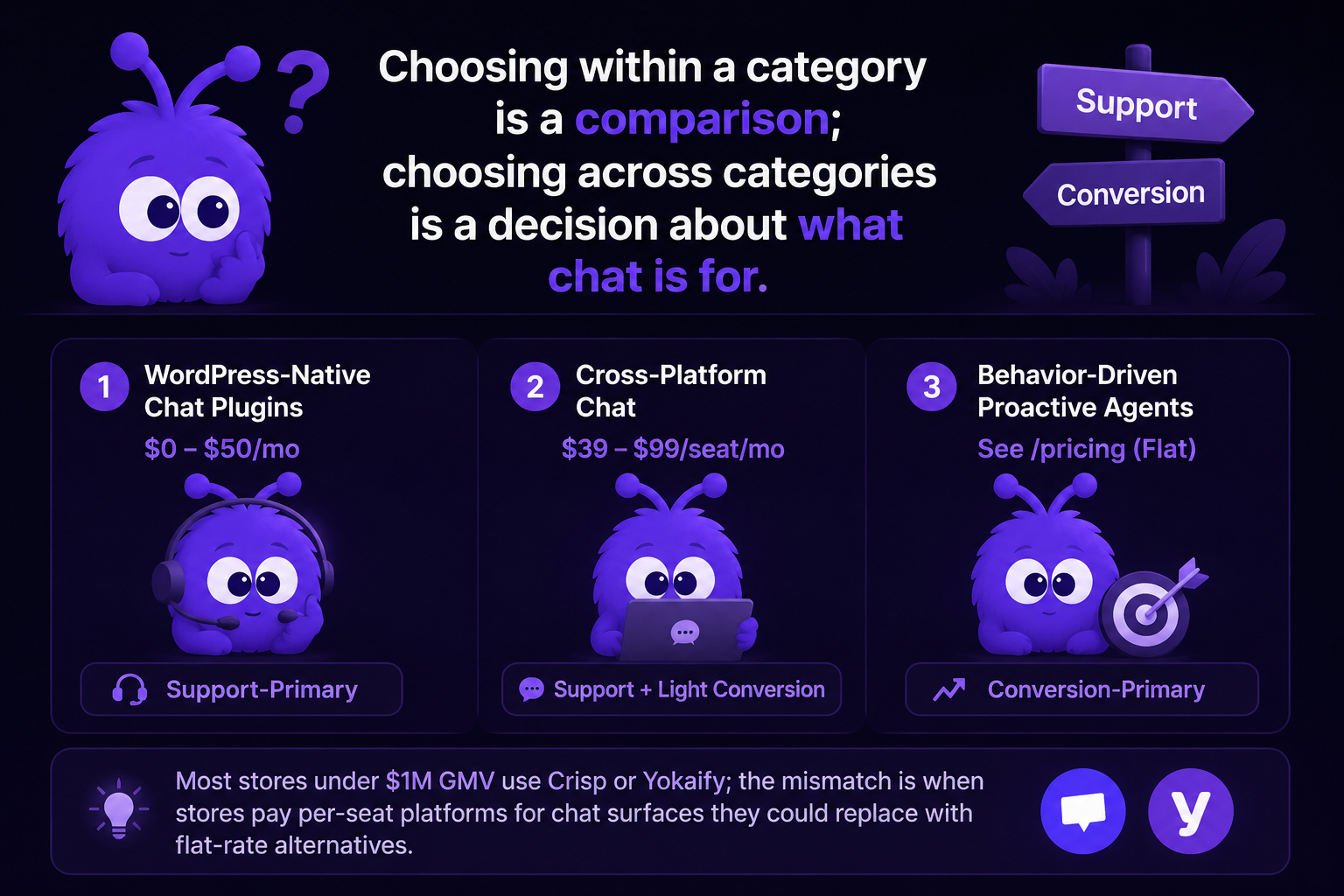
The three categories
| Category | Examples | Price range | Best for |
|---|---|---|---|
| WordPress-native chat plugins | Crisp, Tidio, Tawk.to, JivoChat | $0-50/mo | Support-primary, low-traffic |
| Cross-platform chat with WooCommerce integration | Intercom, HubSpot, Drift, LiveChat | $39-99/seat/mo | Support + light conversion, growing teams |
| Behavior-driven proactive agents | Yokaify, Chatbase, SiteGPT, FastBots | see /pricing flat | Conversion-primary, in-session intervention |
The pattern: each category targets a different primary outcome. Choosing within a category is a comparison; choosing across categories is a strategic decision about what the chat surface should do.
Category 1: WordPress-native chat plugins
The default option for stores wanting basic support chat. Examples and pricing as of May 2026:
- Crisp. Free tier: 2 seats, basic chat. Pro: $25/seat/mo. Generous free tier; clean UX; widely used.
- Tidio. Free tier: 50 conversations/mo. Starter: $29/mo. WooCommerce-aware features (cart abandonment automation).
- Tawk.to. Fully free; ad-supported branding (small "Powered by Tawk.to" on the widget).
- JivoChat. Free for 5 agents; paid $19-39/mo for additional features.
The strengths:
- Easy install (WordPress plugin, 5 minutes).
- WordPress-native (no JS framework conflicts).
The limitations:
- Reactive chat by design; minimal proactive trigger logic.
- Inbox-focused; not optimised for in-session conversion.
- WooCommerce integration usually limited to displaying the cart in the chat for the agent to reference (not for triggering interventions on cart events).
Stores at higher traffic typically upgrade or move to a paid alternative.
Category 2: Cross-platform chat with WooCommerce integration
The platform-class chat tools, used by stores that want a single chat platform across their marketing site, dashboard, and support inbox:
- Intercom. $39-99/seat/mo. Strong inbox, multi-channel (email, chat, in-app), AI add-on (Fin) for $0.99 per resolution.
- HubSpot Chat. Bundled with HubSpot CRM; effectively free if already on HubSpot, $0-1,800/mo otherwise.
- Drift. $50-100+/seat/mo. Sales-focused; conversational marketing positioning.
- LiveChat. $20-59/seat/mo. Mid-tier between Crisp and Intercom.
The strengths:
- Multi-channel inbox (handle email, chat, in-app messages in one tool).
- CRM integration (Salesforce, HubSpot, others).
- Mature feature set (workflows, ticketing, SLAs, macros).
- Analytics and reporting depth.
The limitations:
- Per-seat pricing scales fast; a 5-seat team on Intercom Advanced is $495/mo.
- Chat surface is reactive by default; proactive features available but require configuration.
- Often paid for support features the store does not actually use.
For stores at $5M+ GMV with both significant inbound support and meaningful sales chat, Intercom or LiveChat are reasonable. Below that, the per-seat pricing rarely pays back.
The Yokaify vs Intercom, Yokaify vs Drift, and Yokaify vs HubSpot Chat /vs/ pages cover the head-to-head comparisons in detail.
Category 3: Behavior-driven proactive agents
The newer category, purpose-built for in-session conversion lift:
- Yokaify. Free tier; Starter tier (see /pricing for current rates); Growth tier (see /pricing for current rates); Pro tier (see /pricing for current rates). Behavior-driven proactive intervention with animated mascot and RAG-grounded responses.
- Chatbase. $0-99+/mo. AI-first chatbot with RAG over website; less behavior-driven than Yokaify but lighter price point.
- SiteGPT. $19-249/mo. Similar position to Chatbase; AI-grounded answers from site content.
- FastBots. $20-200/mo. Newer entrant in the space.
The strengths:
- Designed for conversion, not support.
- Flat-rate pricing (no per-seat).
- RAG-grounded responses (cite the actual site content, not the LLM's training-data).
- Behavior-driven triggers (Yokaify; the others are more traditionally reactive).
The limitations:
- Newer category; smaller customer base than Intercom/HubSpot.
- Limited inbox / multi-channel features.
- Best-fit when conversion is the primary goal; less well-fit when support is.
The Onsite Conversion Agent guide covers why this category emerged and what makes it distinct from categories 1 and 2.
Performance considerations on WooCommerce
WooCommerce hosts vary wildly. The same chatbot integration on a $400/mo managed-WordPress host (WP Engine, Kinsta) lands at vastly different CWV than the same integration on $5/mo shared hosting.
Yokaify is built to stay lightweight, so it keeps a light footprint across most host tiers; Intercom's heavier bundle is meaningful regardless of host and compounds badly on slow hosting.
For stores on cheap shared hosting, the chat-tool decision is partly a CWV decision — bolting a heavyweight chat platform onto $5 shared hosting is a bit like fitting a spoiler to a shopping cart: plenty of drag, not much extra speed. The Page Speed Analyzer tool covers the diagnostic side.
WordPress / WooCommerce-specific install considerations
Three things to verify on any WooCommerce chat install:
WP Rocket / W3 Total Cache exclusions. Most chat widgets need their JS to load fresh on each page (chat state varies by visitor). Aggressive minification or JS combination can break the integration. The fix: add the chat widget's JS URL to the optimisation-plugin exclusion list; the same pattern applies across WP Rocket, W3 Total Cache, and LiteSpeed.
WooCommerce cart event integration. Modern WooCommerce dispatches jQuery events (added_to_cart, removed_from_cart, updated_cart_totals) on document.body. Chat tools that read these events can fire interventions on cart state changes. Most WordPress-native chat plugins do not read WooCommerce events natively; cross-platform chat tools and behavior-driven agents typically do.
Theme conflict checking. Some WooCommerce themes inject custom JS into the head that conflicts with chat widgets. The fix: load the chat widget after first paint via async / defer; verify the integration in a development-environment copy of the live theme before deploying.
Yokaify-specific install on WooCommerce
Yokaify offers two install paths for WooCommerce:
Plugin install. WordPress Plugins > Add New > Yokaify. The plugin auto-detects WP Rocket / W3 Total Cache / Litespeed / Autoptimize and surfaces warnings if exclusions are needed. Five-minute install.
Manual install. Paste the Yokaify embed snippet into the wp_footer hook with priority 999. Twenty-minute install. The pattern:
function yk_inject_yokaify {
  if (is_admin) return;
  ?>
  <script src="https://cdn.yokaify.com/embed.js" data-site="YOUR_SITE_ID" async></script>
  <?php
}
add_action('wp_footer', 'yk_inject_yokaify', 999);
Both paths produce the same integration; the plugin path adds the auto-detection of optimisation-plugin compatibility issues.
Further reading
- ToolWooCommerce cart recovery setupCart-recovery configuration for WooCommerce.
- ToolCart abandonment calculatorModel recovered revenue from chat-driven intervention.
- GuideWooCommerce chatbot 2026 implementation guideBeyond buying - how to actually install.
- GuideThe proactive chat playbookThe category claim behind behavior-driven agents.
Frequently asked questions
Three categories: WordPress-native plugins (Crisp, Tidio, $0-50/mo), cross-platform (Intercom, HubSpot, $39-99/seat), behavior-driven proactive agents (Yokaify, Chatbase, see /pricing flat).
Last updated June 10, 2026.